

 English
 Español
 عربى

Home / News / Industry News / PVC Foam Board: Key Factors Buyers Should Check Before Bulk Purchasing
PVC Foam Board: Key Factors Buyers Should Check Before Bulk Purchasing
Article Directory
- 1 Density Grade Is the First Number to Lock Down
- 2 Thickness Tolerance and Flatness Drive Machine Time
- 3 Cell Structure: Free Foam, Celuka and Co-Extruded
- 4 Compliance Paperwork to Demand Before the Deposit
- 5 Batch Consistency and What a Supplier Audit Should Cover
- 6 Landed Cost Math Before You Confirm the Purchase Order
- 7 Practical Answers for Bulk PVC Foam Board Orders
A 40-foot container load of 18 mm PVC foam board at 1220 x 2440 mm runs to roughly 600 sheets and about 19 tonnes at 0.60 g/cm3 density. A drift of 0.05 g/cm3 across that load is enough to change how every sheet machines, holds a screw and takes UV ink. Bulk purchasing failures with this material almost never come down to unit price. They come down to four or five variables that never made it into the purchase order.
What follows is the sequence a factory audit usually surfaces those variables in, from the spec sheet through to the landed cost calculation.
Four checks that decide the order
Density grade, thickness tolerance, cell structure and lead stabiliser documentation account for roughly 80 percent of how a bulk PVC foam board order performs after it lands in the warehouse.
Density Grade Is the First Number to Lock Down
Density is the single specification that most reliably predicts how a PVC foam board behaves downstream, and it is also the easiest one for a supplier to leave vague on a quotation.
 Standard 1220 x 2440 mm PVC Foam Board for SignageA standard-size foamed PVC sheet for signage and displays; confirm density tolerance before ordering because stiffness, weight and screw-holding vary.View Product →
Rigid PVC foam is produced across a 0.30 to 0.80 g/cm3 band. Flexural modulus, screw-holding strength, thermal insulation value and surface hardness all track that number. Two sheets that measure identically at 1220 x 2440 x 18 mm can weigh 26 kg and 34 kg respectively, and nothing on a standard invoice distinguishes them. This is why density has to be written into the purchase order as a target with a tolerance band of plus or minus 0.03 g/cm3, not as a generic grade name.
0.40 g/cm3 Short-run signage, display cores, model making
0.55 g/cm3 Exhibition stands, general CNC routing, wall panels
0.70 g/cm3 Cabinet doors, vehicle interiors, load-bearing frames
Flexural strength by density grade
0.40 g/cm3 10 MPa
0.50 g/cm3 16 MPa
0.60 g/cm3 22 MPa
0.70 g/cm3 30 MPa
Typical published values for rigid PVC foam tested at room temperature. Use them to rank grades, not to replace incoming inspection.
A practical verification step: order three sample sheets from three density bands, weigh each one on a calibrated scale, and divide by the calculated volume. A supplier who cannot supply a density certificate alongside the samples is telling you something about the production line.
Thickness Tolerance and Flatness Drive Machine Time
A commercial tolerance of plus or minus 0.20 mm on a 15 mm board is not the same thing as plus or minus 0.50 mm, and the difference shows up as scrap rate on CNC routers, edge-banders and laminating lines rather than as anything visible on the pallet.
Thickness variation compounds across a stack. If you are laminating fifteen sheets at a time under vacuum pressure, a 0.4 mm spread per sheet turns into a 6 mm cushion at the bottom of the stack, and the bond line fails at the edges before the centre has fully cured. Buyers running automated nesting equipment typically tighten the requirement to plus or minus 0.15 mm and pay a small premium for the sorting step.
| Nominal thickness | Achievable tolerance | Typical end use |
| 3 mm to 6 mm | plus or minus 0.15 mm | UV flatbed printing, retail signage, presentation boards |
| 8 mm to 12 mm | plus or minus 0.20 mm | Exhibition structures, architectural models, partitions |
| 15 mm to 20 mm | plus or minus 0.30 mm | Cabinet carcasses, door panels, bathroom vanities |
| 25 mm to 40 mm | plus or minus 0.50 mm | Carved components, structural inserts, heavy framing |
Flatness is the second dimension to test. Lay a sheet on a certified granite table or a steel straightedge and measure the gap at the four corners and the centre. A bow of more than 3 mm per linear metre will jam an automatic feeder and will also telegraph through thin laminate films.
Cell Structure: Free Foam, Celuka and Co-Extruded
Free foam, Celuka and co-extruded PVC foam board are three separate manufacturing routes rather than three marketing labels, and each one produces a measurably different skin-to-core profile that changes how the sheet cuts, bonds and finishes.
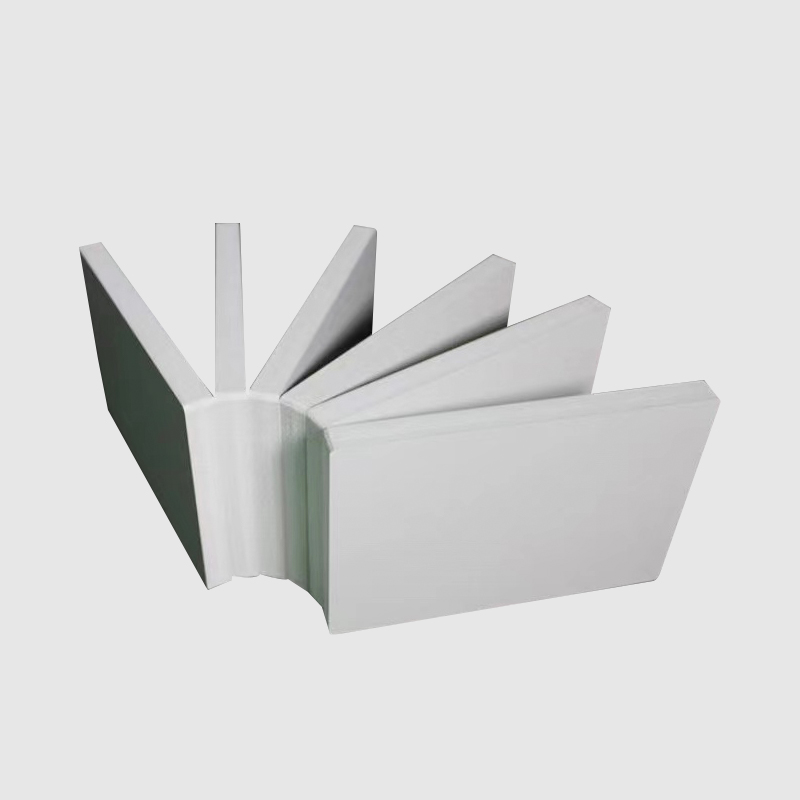 High-Density Celuka PVC Foam Board in 3 mm, 5 mm, 12 mmLarge 4x8 ft Celuka PVC foam sheets with a dense skin and foam core; choose thickness for cutting, bonding, and finishing needs.View Product →
Free foam expands uniformly through the die, so density is consistent from face to core and the surface is matte and slightly open. Celuka uses a cooled die face to freeze a dense skin while the core expands, producing a hard, smooth outer layer over a lighter centre. Co-extrusion runs a separate skin compound over a foam core, which allows the outer layer to be formulated for UV stability or print adhesion independently of the core.
Free foam board
- Uniform density through the full cross-section
- Matte, slightly porous surface
- Lower cost per square metre
- Softer edges after routing
- Best fit: signage, display cores, model work
Celuka and co-extruded board
- Dense skin over a foamed core
- Smooth, closed, print-ready face
- Higher screw pull-out resistance
- Sharp machined edges without tear-out
- Best fit: cabinetry, furniture, wall panels
A 6 mm Celuka sheet and a 6 mm free foam sheet can share the same density number and still fail in completely different applications, because density says nothing about where the material sits in the cross-section.
Compliance Paperwork to Demand Before the Deposit
Ask for lead content and stabiliser documentation before the deposit clears, not after the container has sailed, because re-testing and re-routing a rejected shipment costs more than the entire material value.
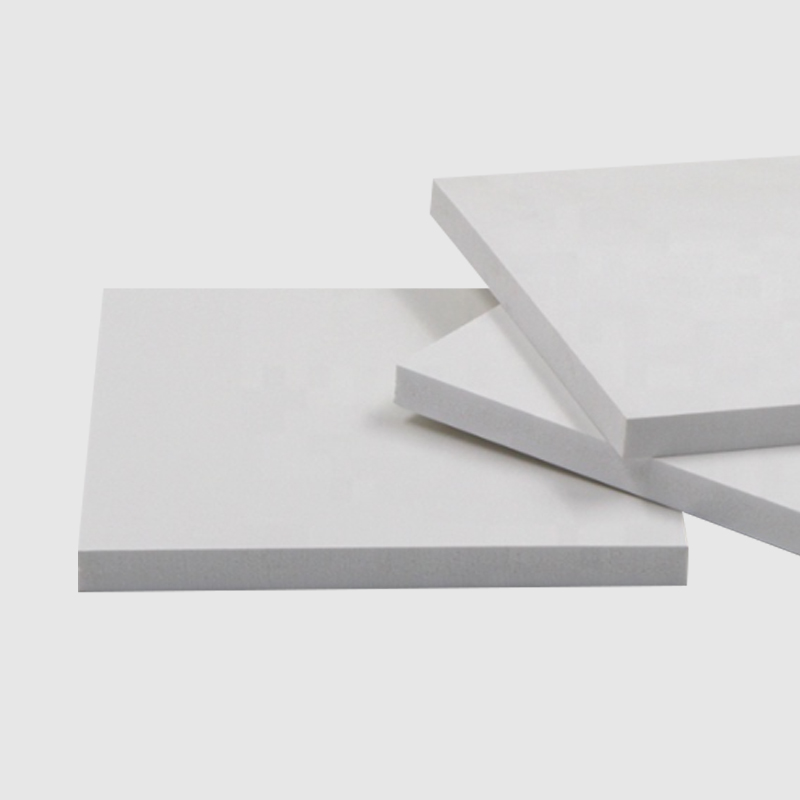 Lead-Free Co-Extruded PVC Foam Board for Cabinet InteriorsAn 11 mm, 0.55-density white cabinet board with lead-free formulation; request batch-specific stabiliser documentation before ordering to verify compliance.View Product →
European Union REACH regulations restrict lead in PVC articles to 0.1 percent by weight, and several buyer specifications in North America and the Nordic region set an internal ceiling of 100 ppm for interior applications. Traditional PVC formulations used lead-based heat stabilisers, and a factory that has not fully converted its lines may still run them on older equipment. The only reliable way to confirm which stabiliser system is in your order is a third-party test report tied to the specific batch number, not to the product family.
Three documents to hold before the deposit: a batch-linked heavy metals test report, a flame spread classification covering the actual thickness you ordered, and a written declaration of the stabiliser chemistry. Anything dated more than twelve months before the production date should be treated as a placeholder.
Fire performance is the second paperwork trap. Flame spread classifications are thickness-dependent, so a rating issued on a 5 mm sample does not automatically cover the 18 mm sheet on the same purchase order. Request a separate classification for each thickness in the shipment.
Batch Consistency and What a Supplier Audit Should Cover
A supplier claiming 25,000 tonnes of annual PVC foam board capacity should be able to show the same density reading across three separate production runs within a 30-day window, and that single test separates a stable extrusion line from an intermittent one.
Consistency problems rarely appear on the first order. They show up on the third or fourth shipment, when a screw and barrel change or a raw material substitution quietly shifts the melt viscosity. The checks below are the ones that catch it early.
Weigh, do not trust the label
Pull one sheet per pallet and weigh it. Density is the fastest proxy for whether the extrusion line is running to the agreed formulation. A 5 percent weight drop on a 30 kg sheet is a 1.5 kg change that will show up as a softer edge on the router.
Compare colour across batches
For coloured PVC foam board, a Delta-E value above 1.5 between two production batches is visible on a finished wall panel. Ask the supplier to state the colorimeter model and the reference standard used for the match.
Request retention samples
A factory running proper quality control keeps a retained coupon from every batch for at least 12 months. If retention samples do not exist, there is no traceability chain to fall back on when a defect appears eight months into a project.
Verify the cooling section
Fine cooling and calibration determine flatness and skin quality more than any other stage of extrusion. Ask how many cooling rollers are in the line and whether the calibration table is adjusted per thickness. Lines running a single fixed setting produce the warping that shows up as rejected panels.
These four checks sit behind most of the common quality problems reported in PVC foam board, including sink marks, internal voids and inconsistent surface gloss.
Landed Cost Math Before You Confirm the Purchase Order
The delivered cost per square metre is set by density, thickness tolerance, packing method and freight class rather than by the quoted price per sheet, and the gap between the cheapest quote and the most expensive one is usually smaller than the gap between their landed costs.
Three cost drivers get underestimated. First, density: a 0.55 g/cm3 board and a 0.65 g/cm3 board can be quoted within 8 percent of each other on a per-sheet basis, but the heavier grade adds roughly 3 tonnes to a container, which changes the freight allocation per square metre. Second, packing: loose sheets in a container absorb moisture during a four-week sea voyage and arrive with edge swelling, while palletised and shrink-wrapped loads arrive dimensionally stable. Third, cut-to-size service: a factory that delivers 1220 x 2440 mm stock is priced differently from one that delivers 600 x 1200 mm panels with 0.2 mm tolerance, and the second option frequently saves more in downstream labour than it costs in unit price.
A worked comparison: 600 sheets at 0.55 g/cm3 versus 600 sheets at 0.65 g/cm3. The heavier load adds about 8 tonnes to the shipment. At typical container freight rates, that is a 15 to 20 percent increase in the logistics line, even though the per-sheet price difference looks like 6 percent on the quotation.
The factors that move PVC foam sheet pricing on bulk orders are therefore worth modelling in a spreadsheet before negotiation, not after.
Practical Answers for Bulk PVC Foam Board Orders
What density should I specify for kitchen cabinet doors?
Specify 0.55 to 0.65 g/cm3 for door panels and 0.60 to 0.70 g/cm3 for carcass components that carry hinges and drawer runners. Below 0.50 g/cm3, screw pull-out resistance drops sharply and hinge plates begin to work loose after roughly 8,000 to 10,000 open-close cycles.
How much does one 4x8 sheet of 18 mm PVC foam board weigh?
At 0.60 g/cm3, an 18 mm sheet measuring 1220 x 2440 mm weighs approximately 32 kg. The same sheet in a 0.50 g/cm3 grade weighs about 27 kg, and at 0.70 g/cm3 it reaches roughly 38 kg. Always calculate the container payload from the density grade you actually specified, not from a generic figure.
Which certificate should a bulk order reference?
Reference a batch-linked test report rather than a generic certificate. A valid PVC foam board submission typically includes a heavy metals report showing lead below 0.1 percent by weight in line with EU REACH, a flame spread classification issued for the exact thickness shipped, and a dimensional inspection record covering thickness, length, width and diagonal difference.
Can I mix thicknesses in a single container?
Yes, and it is usually worth doing. Mixing 5 mm, 12 mm and 18 mm stock in one load can improve container fill by 12 to 18 percent compared with a single-thickness load, because thinner sheets nest into the voids left by thicker pallets. The one condition is that all thicknesses come from the same production batch window, so the colour and density match across the shipment.
Recommended NEWS:
PVC Free Foam Board's multiple applications and environmental advantages in the field of transportation
What environmental measures are used in the production of White Laminated PVC Free Foam Boards?
White Laminated PVC Free Foam Boards: Environmentally friendly and sustainable production
The price of PVC Foam Board is affected by the cost of raw materials
Custom Laminated PVC Foam Board: A versatile material with excellent waterproof performance
Fireproofing of Custom Laminated PVC Foam Boards
Related Products


Jiatao Industry Co., Ltd. is a professional manufacturer of polyvinyl chloride plastic boards in China, dedicated to the production of PVC foam boards, plastic wood foamboards, as well as colorful pVC for extruded foam board sheet manufacturers.
-
ADDRESS
No.65 Liminba, Yinong Town, Xiaoshan District, Hangzhou, Zhejiang, China
-
EMAIL
-
PHONE
+86-17816178586
MOBILE SITE



Copyright © Jiatao Industry Co., Ltd. All Rights Reserved.
Custom Rigid PVC Plastic Foam Boards Suppliers

Contact Us