

 English
 Español
 عربى
عربى
Home / News / Industry News / PVC Board Sheets: The Key Material Properties for Commercial Applications
PVC Board Sheets: The Key Material Properties for Commercial Applications
Article Directory
- 1 What Defines a PVC Board Sheet
- 2 Core Material Properties That Drive Commercial Decisions
- 3 Density Grades and Performance Trade-offs
- 4 How the Manufacturing Process Changes Sheet Behaviour
- 5 Selecting the Right Sheet for Commercial Applications
- 6 Specification Checklist for Commercial Procurement
- 7 Frequently Asked Questions
A 5 mm white PVC foam sheet at 0.55 g/cm3 density weighs about 6.7 kg in a 1220 x 2440 mm board - light enough for one person to carry through a sign shop, rigid enough for a freestanding retail display. That combination of low weight and dimensional stability is why PVC board sheets anchor the material lists of signage fabricators, cabinet makers, and interior contractors. Commercial purchasing decisions fail when a spec sheet is read superficially: density, skin structure, and fire rating change how the same material behaves across real installations.
What Defines a PVC Board Sheet
A PVC board sheet is a rigid, closed-cell foamed polyvinyl chloride panel produced by extrusion. The cellular core, typically 0.1 to 0.5 mm in cell diameter, gives the material its signature combination of low weight, stiffness, and moisture resistance, at a fraction of the cost of solid PVC sheet.
In specification terms, a PVC board sheet is any foamed PVC panel with a closed-cell core and a density between 0.4 and 0.9 g/cm3.
Three manufacturing routes define the commercial market:
- Free-foam board: a uniform cellular core with a matte surface offering the lowest cost and easiest routing.
- Celuka board: a dense outer skin over a foamed core, delivering a harder surface and better screw retention.
- Co-extruded board: a solid PVC cap fused to a foamed core, providing the best surface finish and flexural rigidity.
Core Material Properties That Drive Commercial Decisions
The properties that matter commercially are the ones that survive fabrication, installation, and years of service. Four specifications determine whether a board will perform or fail in the field.
Density and mechanical strength
Commercial PVC board sheets range from 0.4 to 0.9 g/cm3. Higher density raises flexural strength and screw-holding capacity but adds weight and cost. A 0.6 g/cm3 board is the practical baseline for cabinetry, while 0.5 g/cm3 is common for signage. For a closer look at how density maps to stiffness and strength, see our 4 x 8 structural-density guide.
Water resistance
Closed-cell foam absorbs less than 1.5% water by weight after 24-hour immersion in standard formulations. This keeps the board dimensionally stable in humid environments where plywood and MDF swell, warp, or delaminate.
Fire performance
PVC is inherently flame-retardant because of its chlorine content. Most commercial grades meet UL 94 V-0 or a Class B1 building standard, but the exact rating depends on the additive package, so the certificate must be verified per batch.
UV and weathering
Unprotected PVC foam yellows and loses impact strength outdoors. Co-extruded caps with UV stabilizers extend outdoor service life significantly, which is why outdoor signage specifications almost always call for capped board.
0.4-0.9 g/cm3Usable density range
< 1.5%Water absorption after 24 h
UL 94 V-0Common fire rating
3-30 mmStandard thickness range
The single most important number on a PVC board spec sheet is density. It predicts stiffness, screw pull-out resistance, surface hardness, and price.
Density Grades and Performance Trade-offs
Density is not a quality score; it is a design parameter. Each grade solves a different problem, and buying the cheapest grade for a demanding application is the most common source of field failure.
| Density range | Typical applications | Main trade-off |
| 0.4-0.5 g/cm3 | Exhibition boards, lightweight signage | Lowest cost, weak screw retention |
| 0.5-0.6 g/cm3 | UV printing, POP displays, architectural models | Best all-round balance |
| 0.6-0.7 g/cm3 | Cabinet doors, furniture panels | Heavier, cleaner edge finish |
| 0.7-0.9 g/cm3 | Countertops, vehicle interior panels | Approaches solid PVC performance |
Plywood and MDF warp in humid rooms; free-foam PVC board does not. That single difference is why wet-area cabinetry is migrating to PVC-based panels.
Weight comparison with common alternatives
The weight gap between PVC board sheets and traditional sheet materials is one of the most cited reasons for switching materials. The chart below compares a 1220 x 2440 x 15 mm panel across five materials.
Figure 1. Panel weight by material for a 1220 x 2440 x 15 mm sheet.
How the Manufacturing Process Changes Sheet Behaviour
Specifiers who buy only on thickness and price often miss the difference between free-foam, Celuka, and co-extruded boards. The surface layer changes machining behavior, paint adhesion, and long-term durability more than any thickness difference.
Free-foam board
Uniform cellular structure with a matte face. Easy to cut and route, lowest cost, and adequate for short-life signage, modeling, and interior display where surface hardness is secondary.
Celuka board
A dense skin encapsulates the foamed core, producing a harder surface, tighter edges, and better paint and film adhesion. The standard choice for cabinet doors, furniture panels, and any part that needs a smooth, durable face.
Co-extruded board adds a solid PVC cap layer to both faces, and can be produced as white, colored, woodgrain, or marble-effect finishes. Surface hardness, rigidity, and UV resistance are the highest of the three types, making capped board the default for outdoor signage, bathroom cabinets, and high-traffic furniture.
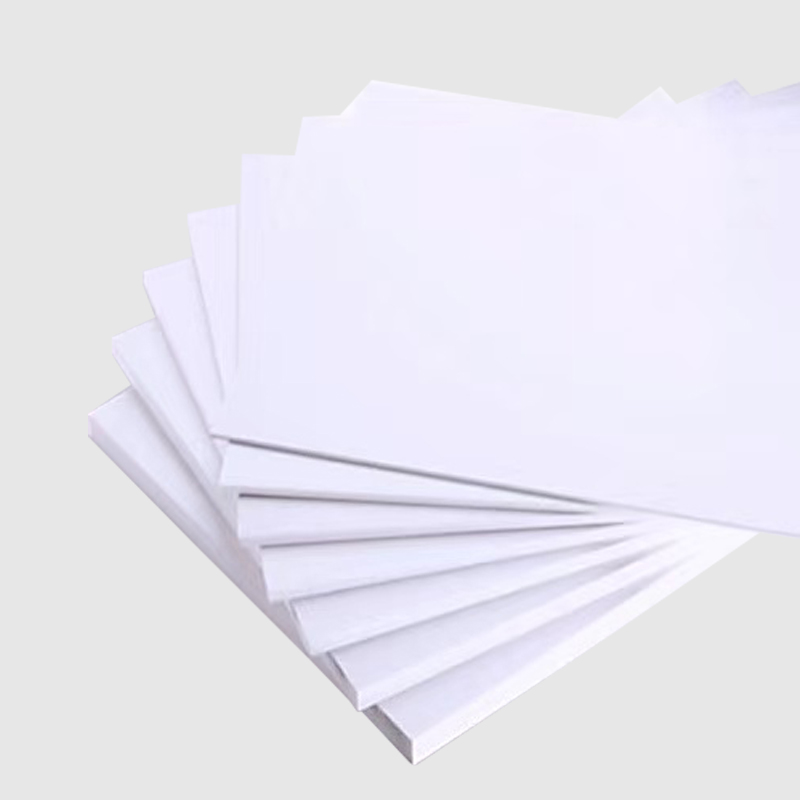 Co-extruded PVC Foam Board for High-Traffic Furniture and SignageThis board combines a solid cap layer with uniform density, offering superior UV resistance and screw-holding strength. Its smooth surface suits edge finishing and painting, making it ideal for default exterior and furniture applications.View Product →
Colored boards are either through-colored during extrusion or laminated with decorative films. Through-colored board keeps its appearance after edge routing, while laminated board adds texture and woodgrain realism at lower cost.
Surface structure decides the fabrication route. A Celuka skin routes cleanly and accepts paint; a co-extruded cap prints and laminates better than most plywood surfaces.
Selecting the Right Sheet for Commercial Applications
Application requirements should drive the grade, not the other way around. The following mapping reflects standard commercial practice across three major sectors.
Signage and graphics
For UV printing, a smooth, closed surface is mandatory. Sheets in the 3 to 10 mm range with a co-extruded or Celuka face deliver the cleanest ink adhesion and sharpest cut edges for letters and logos.
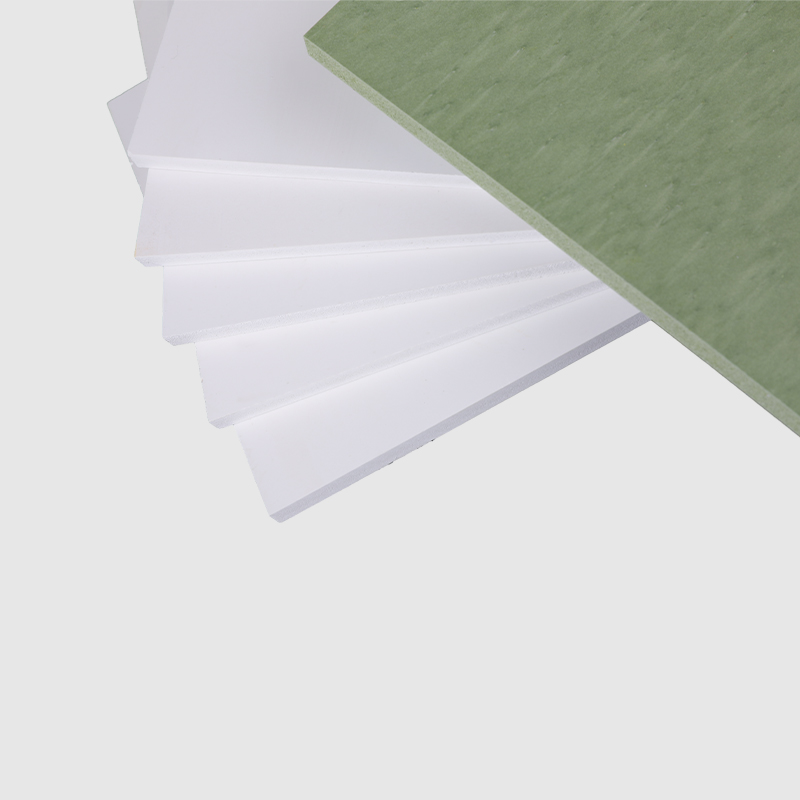 5mm UV-Print-Ready PVC Sintra Sheet for SignboardsA rigid closed-cell board engineered for flatbed UV printers, providing consistent ink adhesion and dimensional stability. Its smooth sealed surface meets the mandatory requirements for sharp letter edges and clean digital output in signage.View Product →
Furniture and cabinetry
Cabinet doors and casework demand 15 to 18 mm board at 0.6 g/cm3 or higher. Screw holding, hinge retention, and edge finish dominate the selection criteria, and a Celuka skin is preferred when the surface will be painted or film-wrapped.
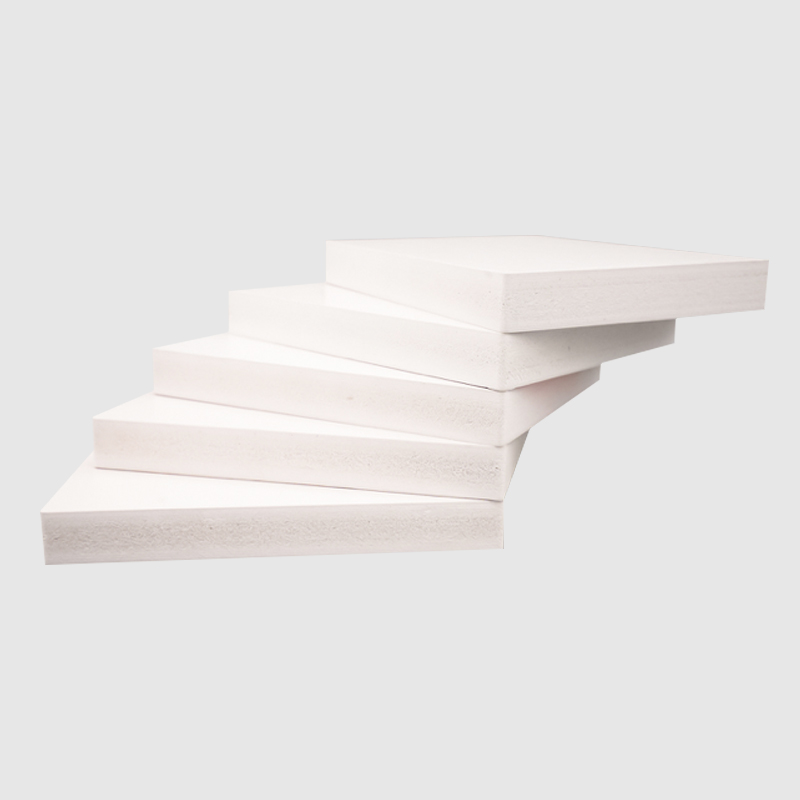 Closed-Cell Colored PVC Foam Sheet for Cabinets and Wet AreasThe colored closed-cell structure offers water resistance and low maintenance, while the dense Celuka skin ensures reliable hinge and screw retention for cabinet doors. Its fire-rated versions suit public corridors, pending code verification.View Product →
Construction and interiors
Wall panels in wet areas benefit directly from the material's water resistance and low maintenance. Use fire-rated grades for public corridors, and always check the local building code before specification.
Transportation and display
Low-density boards keep exhibition stands light enough to assemble, dismantle, and ship repeatedly. High-density boards serve vehicle interior panels where stiffness per kilogram is critical.
Specification Checklist for Commercial Procurement
Verify six items before placing a purchase order. Suppliers such as Jiatao Industrial Co., Ltd., which operates more than 25,000 tonnes of annual PVC board capacity from an 11,000 m2 plant, can usually provide batch-level documentation on request.
- Density grade in g/cm3, confirmed against the application requirement
- Board dimensions and thickness, including tolerance
- Surface type: free-foam, Celuka skin, or co-extruded cap
- Fire rating certificate valid for the destination market
- Lead, cadmium, and REACH compliance documentation
- UV stabilization for outdoor or high-light installations
Ask the supplier for batch-level test certificates. A manufacturer that cannot document density and fire rating cannot guarantee board performance.
Frequently Asked Questions
What is the difference between PVC foam board and solid PVC sheet?
A PVC foam board has a closed-cell cellular core that makes it roughly 30 to 50 percent lighter than solid PVC at equal thickness. Solid PVC is stronger and more impact-resistant, but foam board wins for signage, furniture, and interior panels because it is cheaper, lighter, and easier to machine.
Can PVC board sheets be used outdoors?
Yes, but only with a UV-stabilized co-extruded cap or an added protective coating. Unprotected free-foam board yellows and becomes brittle within months of direct sun exposure.
How do I choose between free-foam and Celuka board?
Choose free-foam board for lightweight, cost-driven projects such as exhibition displays and architectural models. Choose Celuka when you need a harder surface, cleaner routed edges, or better paint and film adhesion for furniture and cabinet doors.
What thickness should I use for cabinet doors?
Most cabinet doors use 15 to 18 mm board at 0.6 g/cm3 or higher density. Thinner high-density board can work, but hinge screws pull out more easily in material under 15 mm.
The right PVC board sheet is the one whose density, surface, and fire rating are verified against the application, not the cheapest sheet a supplier has in stock.
Recommended NEWS:
The profound influence of production process on the weather resistance of PVC Foam Board
The price of PVC Foam Board is affected by the cost of raw materials
Material and performance innovation of PVC ceiling panels
The manufacturing process of PVC co-extruded foam board and the core advantages of its co-extrusion technology
PVC Free Foam Board's multiple applications and environmental advantages in the field of transportation
Custom Laminated PVC Foam Board: A versatile material with excellent waterproof performance
Related Products


Jiatao Industry Co., Ltd. is a professional manufacturer of polyvinyl chloride plastic boards in China, dedicated to the production of PVC foam boards, plastic wood foamboards, as well as colorful pVC for extruded foam board sheet manufacturers.
-
ADDRESS
No.65 Liminba, Yinong Town, Xiaoshan District, Hangzhou, Zhejiang, China
-
EMAIL
-
PHONE
+86-17816178586
MOBILE SITE



Copyright © Jiatao Industry Co., Ltd. All Rights Reserved.
Custom Rigid PVC Plastic Foam Boards Suppliers

Contact Us