

 English
 Español
 عربى

Home / News / Industry News / PVC Co-Extruded Foam Board vs Standard PVC Foam Board: Manufacturer Guide
PVC Co-Extruded Foam Board vs Standard PVC Foam Board: Manufacturer Guide
Article Directory
- 1 Co-Extruded or Standard: The Short Answer for Manufacturers
- 2 How the Two Extrusion Lines Actually Differ
- 3 Density, Skin Hardness and Stiffness: The Numbers That Decide the Application
- 4 Cost per Square Meter and Total Cost per Finished Part
- 5 Machining, Printing and Joining on the Production Floor
- 6 Procurement Checklist: Checks Before a Sheet Is Approved
- 7 Questions Buyers Ask Before Switching Grades
Sheet Selection Note
A cabinet door line running 1,220 x 2,440 mm sheets rejects a board for three reasons: the face fuzzes under a down-cut router bit, a hinge screw pulls out of its pilot hole, or a printed graphic lifts at the edge after two weeks in a warm room. Those three failures separate co-extruded PVC foam board from standard free-foam sheet more reliably than any headline number on a quotation.
Both boards look identical in a stack, both run on the same CNC router, and both are normally quoted within 15 to 25 percent of each other per square meter. The difference lives in the outer 0.2 to 0.5 mm of the sheet, and a workshop notices it long before a specification table does.
0.2 to 0.5 mm
The outer 0.2 to 0.5 mm carries the decision. It is where a co-extruded board keeps its dense skin, and where a free-foam board simply stops expanding.
Co-Extruded or Standard: The Short Answer for Manufacturers
A co-extruded PVC foam board reaches roughly 1.5 to 2.5 times the surface hardness of a standard free-foam board at equal thickness, holds a screw 1.5 to 2 times better, and costs 15 to 25 percent more per square meter.
Standard PVC foam board, also sold as free-foam board, is a single-layer sheet in which the entire cross-section is expanded by a chemical blowing agent, so density stays close to uniform from face to core, typically 0.35 to 0.65 g/cm3 depending on grade.
Co-extruded PVC foam board is produced on a line with two extruders feeding one die: a foamed core is bonded inside the die to a thin, unfoamed or lightly foamed skin, which creates a high-low-high density profile through the thickness.
That structural difference drives everything downstream. A free-foam sheet at 0.45 g/cm3 is a compromise material: uniform, inexpensive, easy to bond, and soft enough that a router bit tears cells instead of cutting them. Manufacturers rarely lose money on the sheet itself. They lose it on the next operation.
1.5x - 2.5x surface hardness against free foam at equal thickness
15 - 25% higher sheet price per square meter
0.55 - 0.80 g/cm3 typical overall density of a co-extruded board
One caution before the numbers. Density grades overlap, and a 0.65 g/cm3 free-foam sheet is stiffer than a 0.50 g/cm3 co-extruded sheet. Every comparison below is made at equal thickness; anything else will mislead a buying decision.
How the Two Extrusion Lines Actually Differ
Co-extrusion feeds two melt streams into a single die, while free foam feeds one, and that process difference explains hardness, screw holding, print quality and scrap rate.
A free-foam line runs one extruder. PVC resin, calcium carbonate filler, stabilizer and a chemical blowing agent are melted and pushed through a flat die; the melt expands as pressure drops and is calibrated to thickness between chilled rolls or plates. Density is set by blowing-agent loading and cooling speed, and the face you get is the face the foam produces, filler included.
A co-extruded line adds a second, smaller extruder that feeds a skin compound, normally unfilled or low-filler virgin PVC, into a feedblock or multi-manifold die where it meets the foamed core before the melt leaves the die. Skin thickness is set by skin extruder output and die gap, and typical values run 0.2 to 0.5 mm per face. Because skin and core are joined as melts, the bond is continuous rather than a lamination. The full sequence is described in a Jiatao Industrial technical note on the co-extrusion process and its core advantages.
A third route, the Celuka process, sits between the two. It uses one extruder but cools the outer surface hard against a calibrating mandrel, so a solid skin forms from the same melt. Celuka sheet gives a harder face than plain free foam without a second extruder and remains a common furniture and advertising specification between 3 mm and 17 mm.
 Rigid Celuka PVC Foam Sheet for Printing and FurnitureCeluka PVC foam board with impact-resistant skin, 3-5 mm thickness, printable matte surface, and 2-3x screw retention for signage, POP displays, and lightweight furniture.View Product →
- Skin material is separate: the face can be unfilled PVC even when the core carries 20 to 40 percent calcium carbonate.
- The density profile is deliberate: high at both faces and low in the middle, which raises stiffness without adding weight.
- Thickness is limited: co-extruded production normally stops at 18 mm, while free foam runs from 3 mm to 330 mm.
- Line cost is higher: the second extruder, the feedblock and tighter gauge control are what the 15 to 25 percent premium pays for.
Density, Skin Hardness and Stiffness: The Numbers That Decide the Application
At equal thickness, a 0.60 g/cm3 co-extruded board delivers about 1.5 times the flexural stiffness and 1.6 times the surface hardness of a 0.45 g/cm3 free-foam board, and the gap widens once a screw is driven into it.
| Property | Standard free-foam PVC | Co-extruded PVC foam |
| Overall density (ISO 845 / ASTM D1622) | 0.35 - 0.65 g/cm3 | 0.55 - 0.80 g/cm3 |
| Face hardness, Shore D | 30 - 45 | 50 - 68 |
| Flexural stiffness (ASTM D790) | 1.00 reference | 1.50 - 1.90 |
| Screw pull-out, No. 8 screw | 1.00 reference | 1.50 - 2.00 |
| Wetting for UV ink | 30 - 34 mN/m, primer often required | 38 - 42 mN/m, direct print |
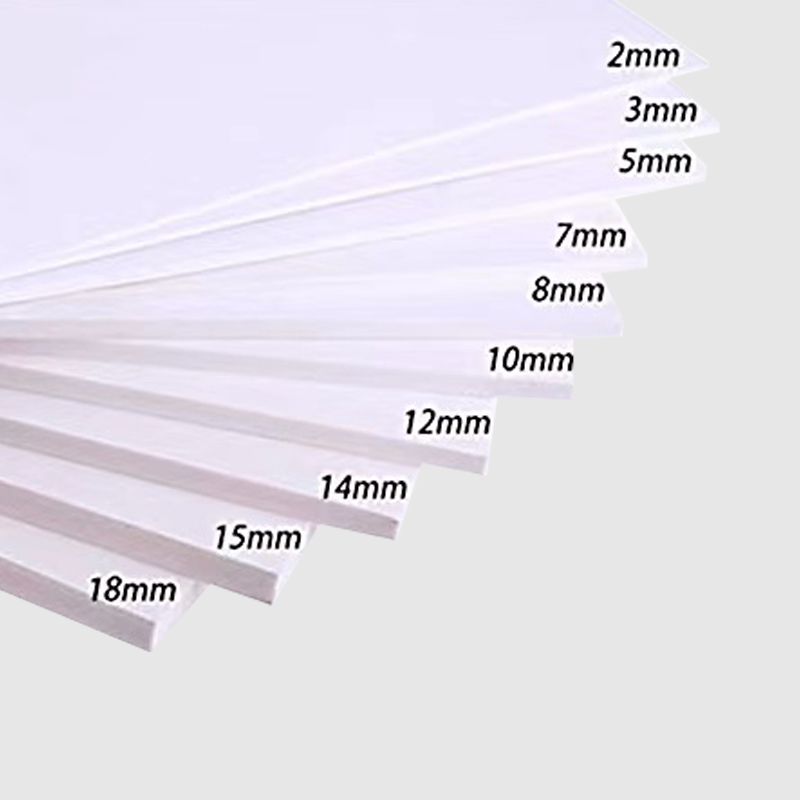
| Production thickness range | 3 - 330 mm | 3 - 18 mm |
| Edge after routing | Fuzz and tear-out common | Clean edge, light sanding |
Relative index at equal thickness, free-foam board set at 100; values reflect mill benchmarks, not absolute laboratory results.
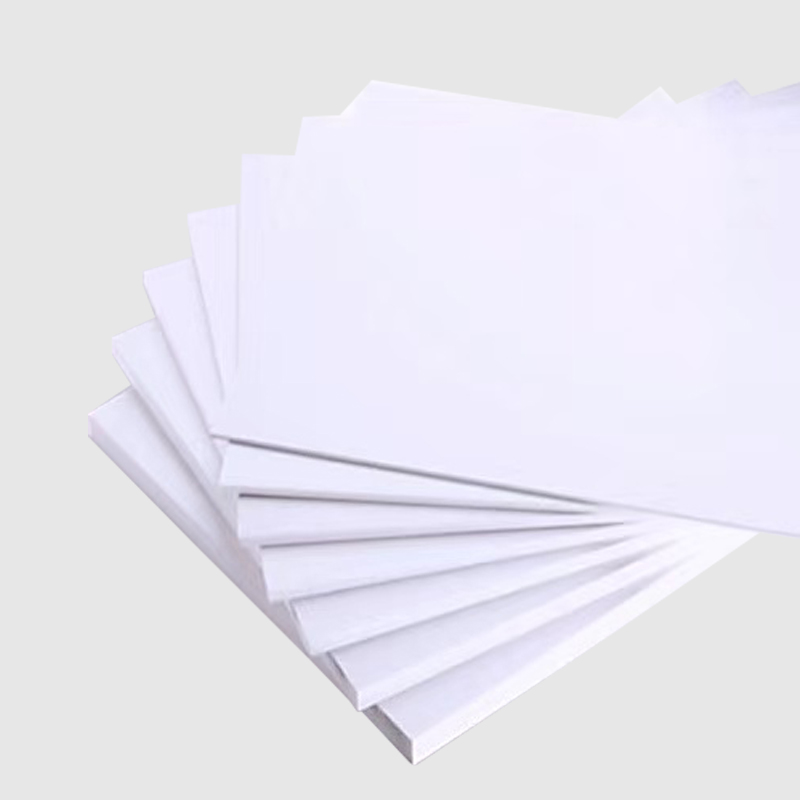 PVC Co-Extruded Foam Board for Waterproof and Acoustic ApplicationsCo-extruded PVC foam board offers extra rigidity, waterproof and sound-insulating performance for indoor or outdoor installations, with easy-clean surfaces and low-maintenance use.View Product →
Read the table by column, not by row. Density alone says little, because density plus skin hardness plus wetting angle is what predicts whether a nested router will make money on the job.
Cost per Square Meter and Total Cost per Finished Part
Co-extruded sheet carries a 15 to 25 percent price premium per square meter, yet because it is stiffer, a 12 mm co-extruded board can replace a 15 mm free-foam board, which brings cost per finished part back to within 5 to 10 percent.
The arithmetic becomes clear once scrap is included. If a 15 mm free-foam panel needs an extra sanding pass and more hinge drilling rework, the material saving disappears in labor. If the same panel is a back board that never meets a screw or a print head, the premium buys nothing at all.
Co-extruded pays off when
- The part carries a screw, hinge or threaded insert.
- The face is printed directly and must resist edge lift.
- Thickness sits under 18 mm and stiffness limits the design.
- The panel stays visible after assembly.
Free foam is the better buy when
- The panel is a back board, spacer or template.
- Parts are bonded or stapled rather than screwed.
- The job needs 20 mm to 330 mm thickness.
- A 0.45 g/cm3 grade already passes the bend test.
Thickness is the other lever. Buyers who need 20 mm and above sit outside co-extruded supply, and 25 mm to 330 mm work is a free-foam or laminated-panel decision.
Machining, Printing and Joining on the Production Floor
The dense skin changes tool behavior: an O-flute or down-cut router bit leaves a clean edge on co-extruded sheet at feed rates that tear the face of free foam, and UV ink wets the skin at 38 to 42 mN/m without a primer.
- Routing: free foam needs slower feed and a sharp down-cut geometry, while co-extruded sheet tolerates higher feed with less fuzz.
- UV printing: free foam often needs a primer to reach 38 mN/m wetting, while co-extruded faces print directly and hold ink at the edge.
- Bonding: solvent cement works on both, but a dense skin resists penetration, so co-extruded joints need light abrasion first.
- Fixings: a No. 8 screw in 16 mm co-extruded board holds roughly 1.5 to 2 times the load of the same screw in free foam.
- Thermal movement: PVC foam expands about 0.05 to 0.07 mm per meter per degree C, so long panels need the same expansion gap in either grade.
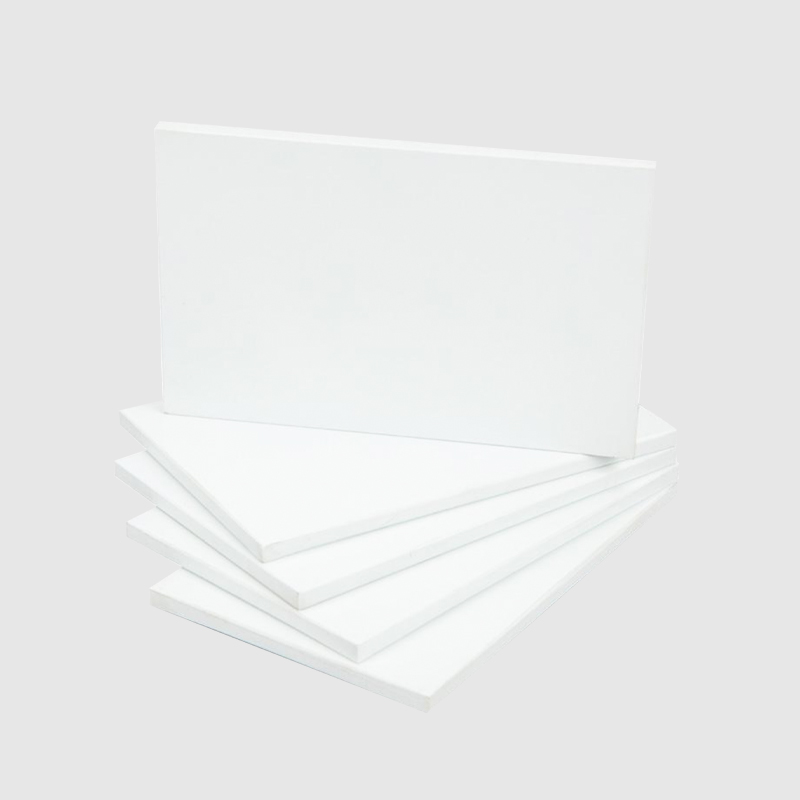 Jiatao White PVC Foam Sheet for Printing and FabricationClosed-cell PVC foam sheet in rigid or Celuka options, 3-10 mm thick, printable matte surface, water- and mould-resistant for signage, cabinetry, and industrial uses.View Product →
Procurement Checklist: Checks Before a Sheet Is Approved
Six checks cover the failure modes that reach a production line: density, skin thickness, thickness tolerance, documentation, sample machining and lot consistency.
- Specify density and skin thickness as two separate numbers, because a 0.60 g/cm3 board with a 0.25 mm skin behaves differently from the same density with a 0.10 mm skin.
- Ask for the test method, not only the value: density should reference ISO 845 or ASTM D1622 with a stated tolerance, usually plus or minus 5 percent.
- Set thickness tolerance by operation, since nested routing and hinge drilling need tighter control than flat signage panels.
- Confirm chemical and fire documentation: a REACH SVHC statement below 0.1 percent by weight, a RoHS lead figure under 0.1 percent, and a fire class such as EN 13501-1 B-s1,d0 or ASTM E84 Class A where the panel enters a building.
- Route, drill, print and bond one sheet of each candidate grade in your own shop before the first container ships.
- Agree how color and density are recorded between production runs, and who signs off a deviation.
Questions Buyers Ask Before Switching Grades
Yes when the panel is screwed, riveted or printed directly without a primer. The premium of 15 to 25 percent is measured per square meter, while a rejected print run wastes the ink, the printing time and the sheet on that batch.
Can a higher-density free-foam board match a co-extruded board?
Only partly. Raising free-foam density from 0.45 to 0.65 g/cm3 lifts stiffness close to co-extruded levels, but no skin forms, so surface hardness and screw pull-out stay lower and the panel gets heavier at the same thickness.
What thickness of co-extruded sheet replaces a thicker free-foam sheet?
Two substitutions cover most work: 12 mm co-extruded for 15 mm free foam in cabinet and display panels, and 5 mm co-extruded for 8 mm free foam in printed signage. Confirm each change with a bend test at your own span.
Which documents should travel with a shipment?
Ask for a density report referencing ISO 845 or ASTM D1622, a flexural report to ASTM D790, a fire classification to EN 13501-1 or ASTM E84, and a REACH SVHC declaration below 0.1 percent by weight.
The grade decision rarely turns on the sheet alone; it turns on the operation that follows the sheet, and that is the number worth testing before the next order.
Recommended NEWS:
PVC Free Foam Board's multiple applications and environmental advantages in the field of transportation
Laminated PVC Foam Board has the advantages of being moisture-proof and water-resistant compared to other materials
White Laminated PVC Free Foam Boards: Environmentally friendly and sustainable production
The price of PVC Foam Board is affected by the cost of raw materials
Custom Laminated PVC Foam Board: A versatile material with excellent waterproof performance
Fireproofing of Custom Laminated PVC Foam Boards
Related Products

Jiatao Industry Co., Ltd. is a professional manufacturer of polyvinyl chloride plastic boards in China, dedicated to the production of PVC foam boards, plastic wood foamboards, as well as colorful pVC for extruded foam board sheet manufacturers.
-
ADDRESS
No.65 Liminba, Yinong Town, Xiaoshan District, Hangzhou, Zhejiang, China
-
EMAIL
-
PHONE
+86-17816178586
MOBILE SITE



Copyright © Jiatao Industry Co., Ltd. All Rights Reserved.
Custom Rigid PVC Plastic Foam Boards Suppliers

Contact Us