

 English
 Español
 عربى
عربى
Home / News / Industry News / PVC Foam Board Thickness & Density: How They Affect Performance and Selection
PVC Foam Board Thickness & Density: How They Affect Performance and Selection
Article Directory
A signage workshop in Hamburg ordered 50 sheets of 3 mm low-density PVC foam board for indoor point-of-sale displays. Three months later, 12 sheets had bowed between their aluminium frames, and the printer rejected two more because the surface dimpled under the UV-curing rollers. The replacement order specified 10 mm medium-density material, and the problems stopped. That is the practical difference thickness and density make on a production floor, and it is why experienced buyers do not compare price per sheet alone.
PVC foam board is a rigid plastic sheet with a cellular core, produced by extruding PVC resin with a blowing agent. Two specification values control nearly every performance outcome: thickness, which governs bending resistance, thermal insulation, and load capacity; and density, which governs surface hardness, edge quality, weight, and screw-holding strength. Jiatao Industrial Co., Ltd., an established Chinese PVC board manufacturer, structures its entire product catalogue around combinations of these two parameters.
The engineering rule of thumb: doubling the thickness of a PVC foam board multiplies its flexural stiffness by roughly eight times.
3 mmMinimum common caliper
0.40-0.90Density range in g/cm3
8xStiffness gain per thickness double
330 mmMaximum extruded board thickness
Thickness: The Dominant Control on Stiffness
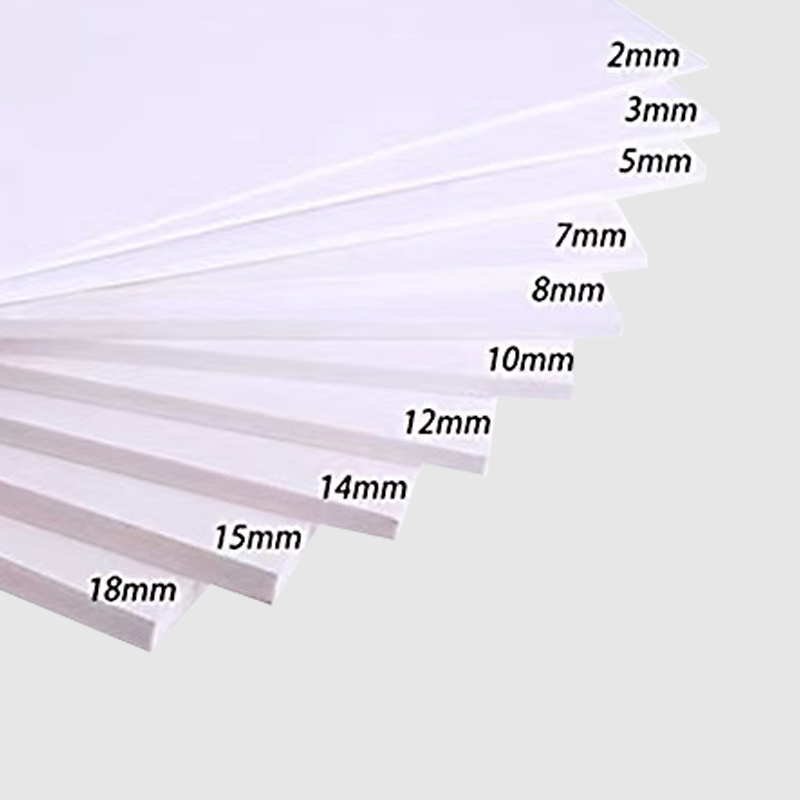
Thickness is the first specification to lock in because bending resistance follows an approximately cubic relationship with caliper. A 10 mm board deflects roughly one-eighth as much as a 5 mm board under the same load, which is why large unsupported panels cannot simply be switched to a thinner material.
Standard thickness bands map to distinct use cases:
- 3-5 mm - signage, UV printing, building models; requires a frame or laminated backing when spans exceed about 600 mm.
- 8-12 mm - exhibition displays, point-of-purchase, wall cladding; balanced stiffness-to-weight for medium spans.
- 15-18 mm - cabinet carcasses, doors, shelving; accepts edge banding and concealed hinges.
- 20 mm and above - structural panels, machine guards, heavy shelves, and architectural templates.
For outdoor signage, 5 mm is the practical minimum for a 4x8 ft sheet used without a backing frame, and most fabricators move to 10 mm or thicker once wind loading is included. A detailed guide to choosing PVC foam board thickness for durable grades compares the options by expected service life and exposure. For UV-printed display panels, a 5 mm high-density sheet keeps the surface flat through the print and cure cycle while holding sharp routed edges.
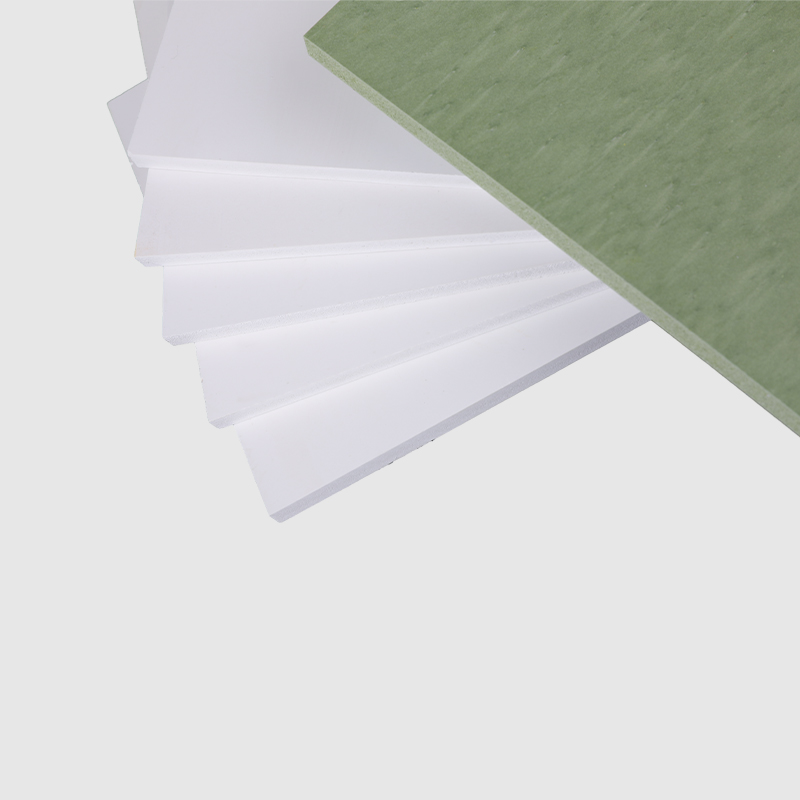 5mm UV-Print-Ready PVC Sintra Sheet for Signage and BannersThis rigid, lightweight board is made for UV flatbed printing, offering a smooth surface and dimensional stability for large-format sign applications. Its closed-cell structure resists moisture, making it practical for indoor and exhibition displays.View Product →
Practical takeaway
Never spec thickness by price alone. Spec it by span, load, and exposure. A 3 mm panel spanning 1 m without a frame will fail regardless of density.
Density: Surface Hardness, Weight, and Fastener Retention
Density determines how a board feels, cuts, and holds fasteners, and it sets the upper limit for mechanical joining. It is expressed in grams per cubic centimetre, and commercial PVC foam boards typically range from 0.40 to 0.90 g/cm3.
| Density band | Typical value | Surface hardness | Screw retention | Best fitted for |
| Low | 0.40-0.55 g/cm3 | Soft, easy to scratch | Poor, strips easily | Short-term signage, models, light displays |
| Medium | 0.55-0.70 g/cm3 | Good for print and routing | Adequate with pilot holes | General fabrication, exhibition work, cladding |
| High | 0.70-0.90 g/cm3 | Hard, impact-resistant skin | Strong, suited to V-grooving and hinges | Cabinetry, long-life signage, furniture panels |
High density is not automatically better. A 0.85 g/cm3 board weighs roughly 55 percent more than a 0.55 g/cm3 board at the same caliper, which increases freight cost and handling effort. A wall-mounted display that never receives a screw does not need a 0.80 g/cm3 core, while a cabinet door with concealed hinges does. For load-bearing furniture panels, Jiatao recommends 18 mm at 0.70 g/cm3 or higher for kitchens and bathroom cabinets, where moisture and repeated hardware loads are both present.
High-density PVC foam board is a cellular PVC sheet with an apparent density of at least 0.70 g/cm3, combining a harder skin with a fine closed-cell core. This is the specification range most often called for in furniture and load-bearing applications.
The way density is distributed through the sheet also matters. A structural density guide for 4x8 ft PVC foam sheets explains how free-foam, Celuka, and co-extruded constructions differ. Celuka boards achieve hard surfaces at a lower average density, cutting weight and material cost. Jiatao supplies 18-20 mm Celuka panels specifically for kitchen-cabinet manufacturing, where the dense skin accepts lamination and the light core keeps panels manageable.
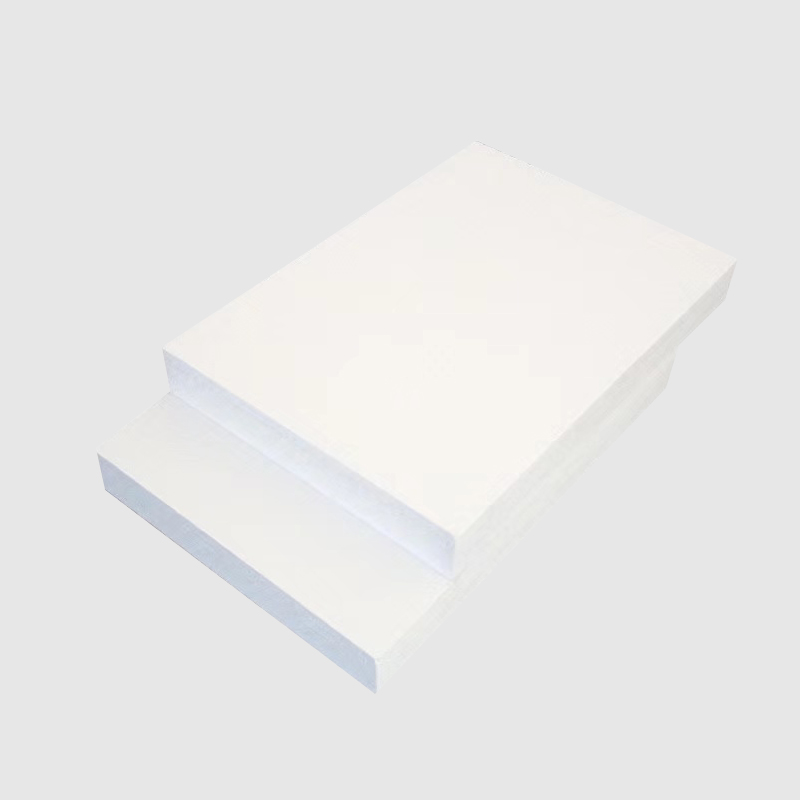 18-20mm Celuka PVC Foam Board for Kitchen CabinetryFeaturing a dense skin over a lighter core, this Celuka board suits kitchen-cabinet manufacturing where lamination and manageable panel weight matter. The specified thickness range provides the rigidity needed for cabinet components.View Product →
Matching Thickness and Density to Real Applications
The correct specification pairs an application priority with a minimum thickness and a density band. Start from the failure mode you want to avoid: bending, surface marking, fastener pull-out, or excessive weight.
| Application | Recommended thickness | Recommended density | Primary requirement |
| UV-printed signage | 3-10 mm | 0.60-0.75 g/cm3 | Flat surface, print adhesion |
| Exhibition displays | 5-12 mm | 0.55-0.70 g/cm3 | Light weight, clean routed edges |
| Kitchen cabinets | 15-18 mm | 0.70-0.85 g/cm3 | Screw holding, moisture resistance |
| Interior wall panels | 6-15 mm | 0.55-0.70 g/cm3 | Flatness, dimensional stability |
| Structural and load-bearing | 20-40 mm | 0.70-0.90 g/cm3 | Stiffness, impact strength |
Thickness-first approach
Choose caliper for span and load, then confirm density. Best for panels with large unsupported areas, such as signs and cladding.
Density-first approach
Choose density for surface and fastener demand, then confirm caliper. Best for furniture, doors, and enclosures where hardware is installed.
Recommended thickness range by application
UV signage 3-10 mm
Displays 5-12 mm
Wall panels 6-15 mm
Cabinetry 15-18 mm
Structural 20-40 mm
0 10 20 30 40 mm
How the Manufacturing Process Changes the Same Thickness and Density
The production process determines where density sits inside the sheet, and that changes how the board behaves at the surface and at cut edges. Jiatao Industrial supplies three main constructions: free foam, Celuka, and co-extruded.
- Free foam - uniform density across the cross-section; lowest cost, easy to route, suitable for short-life signage and displays.
- Celuka - a dense hardened skin over a lighter foam core; high surface hardness and better screw pull-out per unit weight, used for furniture and doors.
- Co-extruded - a solid PVC cap fused onto the foam core in the same pass; clean blade-cut edges and superior dimensional stability, common in premium cabinetry and long-life outdoor boards.
For cabinet and furniture lines where edge banding is not always applied, Jiatao recommends co-extruded sheets in 3-18 mm. The solid cap keeps the cut edge closed and reduces moisture uptake, which is why co-extruded board is the default specification for European kitchen-furniture importers machining panels on CNC centres.
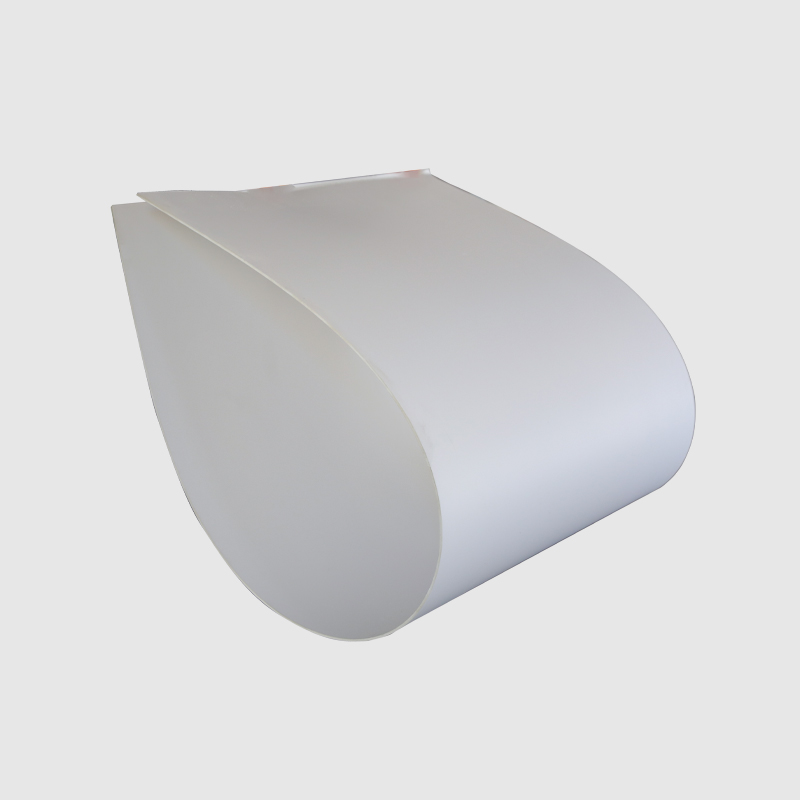 PVC Co-Extruded Foam Board 3-18mm for Furniture and CabinetsThis co-extruded sheet has a solid cap that seals cut edges, reducing moisture uptake—important for CNC-machined panels without edge banding. It offers dimensional stability and smooth surfaces for lamination, painting, or direct finishing.View Product →
Selection short-cut: free foam for short-term indoor use, Celuka for surface-critical furniture, co-extruded for wet areas and CNC machining.
Frequently Asked Questions
What PVC foam board thickness is best for outdoor signage?
For a 4x8 ft sheet mounted without a backing frame, use at least 10 mm in medium to high density. If the sign is framed or laminated, 5 mm can work, but wind load and span must be checked against the board's flexural modulus.
How does density affect screw-holding in PVC foam board?
Higher density improves screw pull-out strength because the cell walls around each fastener thread are thicker and more numerous. For cabinet hinges, use 0.70 g/cm3 or higher at 15-18 mm thickness, and always drill a pilot hole before driving the screw.
Is high-density PVC foam board always the right choice?
No. High-density boards cost more, weigh more, and raise freight costs. For non-load-bearing signage and displays, medium density around 0.60 g/cm3 usually gives the best cost-performance balance.
What is the difference between Celuka and co-extruded PVC foam board?
Celuka forms a dense skin by pushing the foam cells inward as the sheet cools; co-extrusion fuses a solid PVC cap onto the foam core in the same pass. Celuka is harder on the face, while co-extruded board is cleaner at the cut edge and more stable in wet environments.
Recommended NEWS:
PVC Free Foam Board's multiple applications and environmental advantages in the field of transportation
How to deal with board deformation during the production process of PVC Celuka Board?
How to choose the right Laminated PVC foam board according to the surface treatment and lamination type
Laminated PVC Foam Board has the advantages of being moisture-proof and water-resistant compared to other materials
White Laminated PVC Free Foam Boards: Environmentally friendly and sustainable production
Waterproof and moisture-proof performance of WPC Foam Board: materials, technology, application and maintenance
Related Products


Jiatao Industry Co., Ltd. is a professional manufacturer of polyvinyl chloride plastic boards in China, dedicated to the production of PVC foam boards, plastic wood foamboards, as well as colorful pVC for extruded foam board sheet manufacturers.
-
ADDRESS
No.65 Liminba, Yinong Town, Xiaoshan District, Hangzhou, Zhejiang, China
-
EMAIL
-
PHONE
+86-17816178586
MOBILE SITE



Copyright © Jiatao Industry Co., Ltd. All Rights Reserved.
Custom Rigid PVC Plastic Foam Boards Suppliers

Contact Us