

 English
 Español
 عربى

Home / News / Industry News / PVC Foam Board vs PVC Sheet: Key Differences for Commercial and Industrial Projects
PVC Foam Board vs PVC Sheet: Key Differences for Commercial and Industrial Projects
Article Directory
- 1 The Manufacturing Difference That Sets Every Other Property
- 2 Density Predicts Strength, Weight and Thermal Performance
- 3 Fabrication: CNC Feeds, Bonding and Fastening
- 4 Fire, Chemical and Weathering Behavior
- 5 Landed Cost: Where the Price Premium Disappears
- 6 Matching the Material to the Project Type
- 7 Selection Questions Buyers Ask Before Ordering
Two suppliers quote the same 1220 x 2440 mm, 10 mm panel and the landed prices come back three times apart. The gap is almost never margin. It is density. Solid PVC sheet runs at 1.38 to 1.45 g/cm3, while free-foam PVC board runs at 0.35 to 0.60 g/cm3, so identical thickness means a 2.4 to 4.1 times difference in mass, resin consumption and load-carrying behavior.
Buyers get burned in both directions. A signage contractor writes "PVC sheet" on a purchase order for a lobby sign and receives a board that dents under a thumb. A cabinet shop orders foam board for a structural gusset and watches screws strip out at a fraction of the expected load. Both failures begin with treating two material families as a single line item. This comparison separates them by measurable properties: cell structure, density, fastener retention, fire classification, fabrication method and cost per square meter.
Working definition
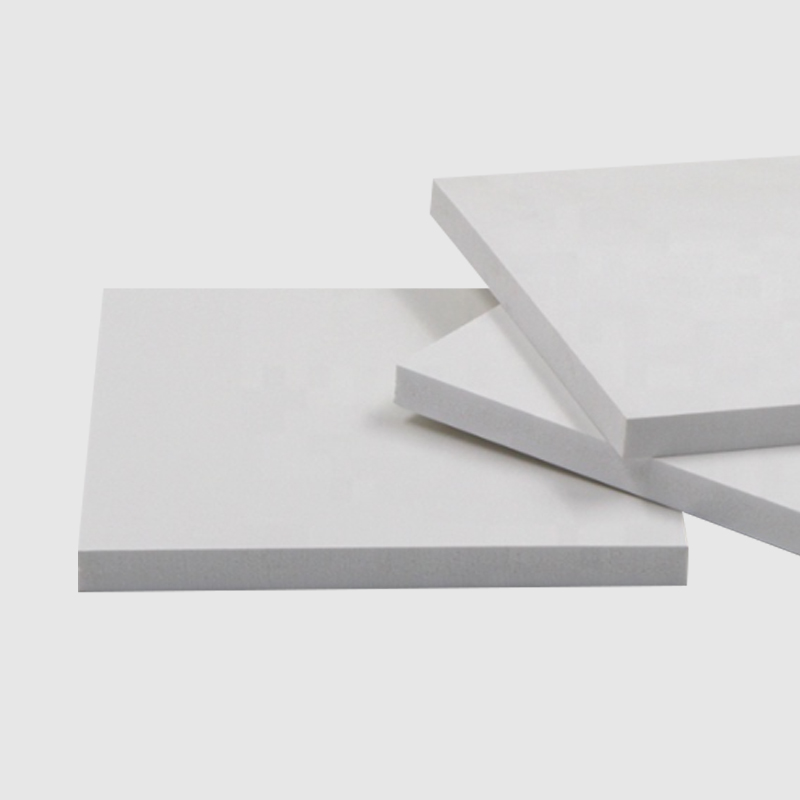
PVC foam board is a cellular, closed-cell PVC panel produced by extrusion with a chemical blowing agent and supplied at 0.35 to 0.80 g/cm3. PVC sheet is a homogeneous, unfoamed rigid PVC compound, classified as cell class 12454 under ASTM D1784 and supplied at 1.38 to 1.45 g/cm3. Forex, Sintra, Celuka and Sunboard are trade names inside the foam family, not synonyms for solid sheet.
The Manufacturing Difference That Sets Every Other Property
Cell structure is the dividing line: foam board expands during extrusion and keeps a cellular core, while PVC sheet is extruded or calendered as a fully dense compound. Every downstream difference, from panel weight to screw retention and thermal conductivity, follows from that single structural fact.
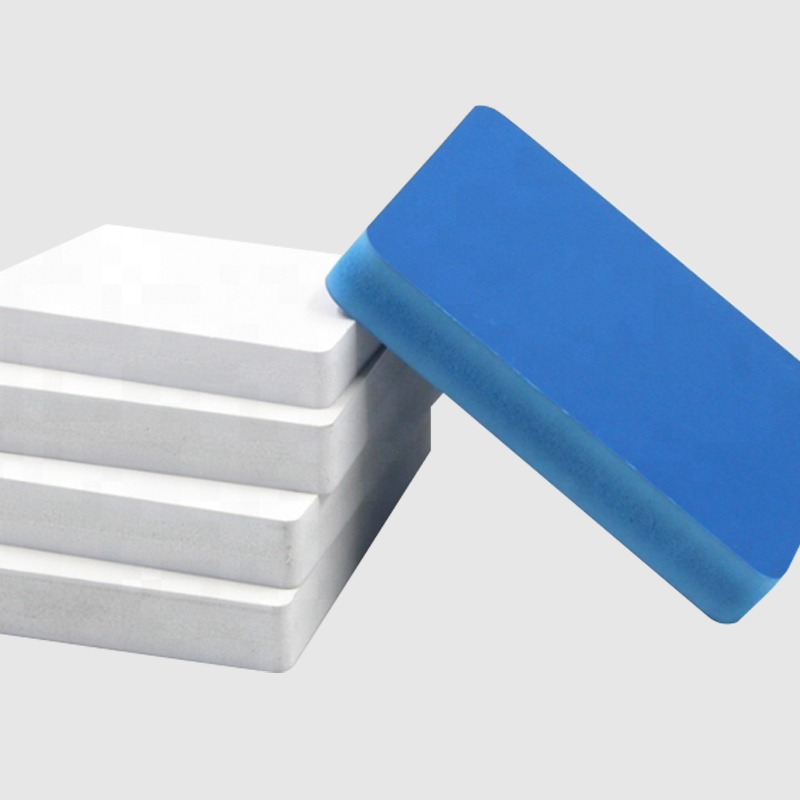
Foam board splits into three sub-families. Free foam, sold under names such as Forex, Sintra and Sunboard, has a uniform cellular core and lands between 0.35 and 0.50 g/cm3. Celuka, also written as cellular or crust foam, forms a dense integral skin over the foam core and runs 0.55 to 0.80 g/cm3. Co-extruded foam board bonds a separately formulated rigid skin onto a foamed core, which raises surface hardness and produces the UV-printable faces that advertising work depends on. Solid PVC sheet is a single product family: fully dense, solvent-weldable, and machined much like a soft metal plate.
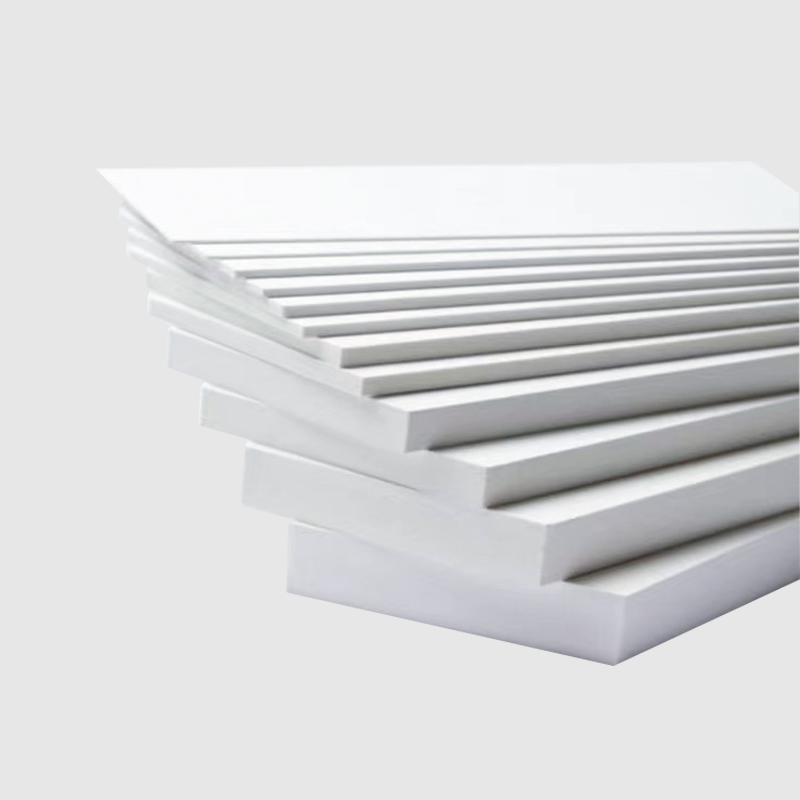 PVC Celuka Foam Board for Furniture and CabinetsHigh-density rigid-surface PVC foam board in 3–17 mm thicknesses, suited to cabinets, shelves, and moisture-resistant indoor or outdoor furniture projects.View Product →
| Property | PVC foam board | PVC sheet |
| Density | 0.35 to 0.80 g/cm3 | 1.38 to 1.45 g/cm3 |
| Cell structure | Closed-cell cellular core | Homogeneous, unfoamed |
| Weight at 10 mm | 3.5 to 8.0 kg/m2 | About 14 kg/m2 |
| Thermal conductivity | 0.035 to 0.045 W/mK | 0.16 to 0.19 W/mK |
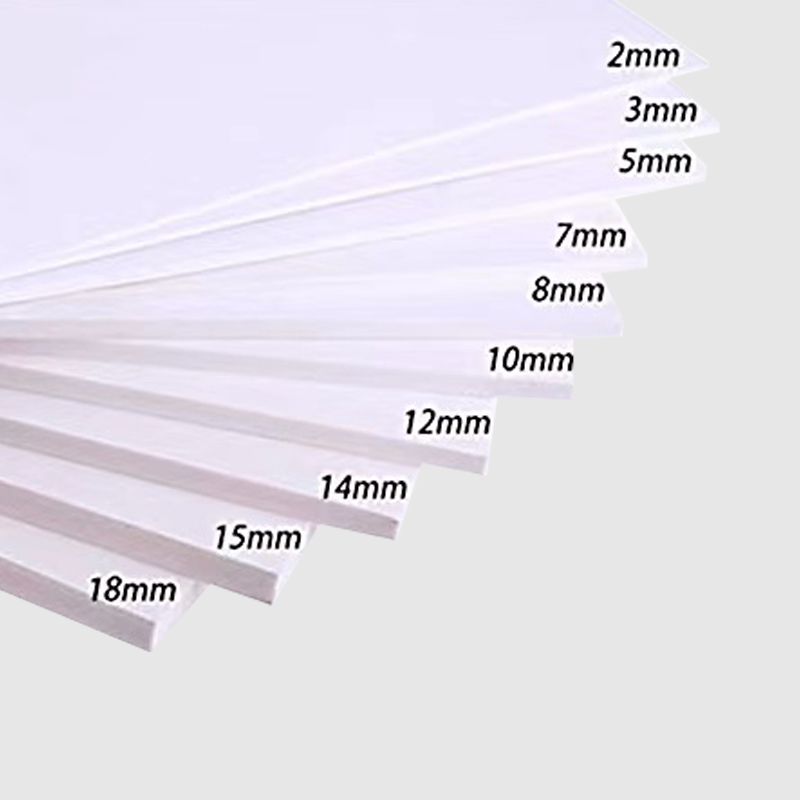
| Common thickness | 1 to 40 mm, blocks to 330 mm | 1 to 25 mm |
| Routed feed rate | 3 to 5 m per minute | 1 to 1.5 m per minute |
| Fastener retention | Low to moderate | High |
| Relative cost per m2 | Baseline | 2.5 to 3.5 times |
Container math: at 5.5 kg per square meter, 10 mm foam board delivers about 4,700 m2 inside a 26-tonne payload. Solid sheet at 14 kg per square meter delivers roughly 1,850 m2 in the same box.
Density Predicts Strength, Weight and Thermal Performance
Density is the strongest single predictor of panel behavior: doubling foam density from 0.40 to 0.80 g/cm3 roughly doubles compressive strength and flexural stiffness while still leaving the panel 43 percent lighter than solid PVC sheet at equal thickness.
0.55 g/cm3 Typical signage and display foam board
1.40 g/cm3 Standard rigid PVC sheet
0.040 W/mK Foam core conductivity
0.17 W/mK Solid PVC sheet conductivity
At 10 percent deformation, a 0.5 g/cm3 foam core carries roughly 3 to 6 MPa in compression. Rigid PVC sheet of the same thickness carries 55 MPa and above. That gap is why solid sheet is used for bearing plates, machined threads and structural spacers, and foam board is not. Cabinet work sits between the two extremes: 15 to 18 mm co-extruded board at 0.55 to 0.65 g/cm3 offers a skin hard enough for door hardware while keeping the panel light enough for hinge adjustment.
 Co-Extruded PVC Foam Board for Cabinets and FurnitureCabinet-grade co-extruded PVC foam board, 3–18 mm, with smooth laminate-ready surfaces, stable dimensions, and processing by CNC routing, sawing, drilling, and painting.View Product →
Density of PVC board grades against solid PVC sheet, in g/cm3
Thermal performance runs in the opposite direction. The cellular core traps still air and drops conductivity to 0.035 to 0.045 W/mK, against 0.16 to 0.19 W/mK for solid sheet. That four-fold gap is why 10 to 20 mm foam board is specified for cold-store linings, refrigerated vehicle panels and insulated display cases, while solid sheet acts as a thermal bridge wherever it appears in the same wall.
Fabrication: CNC Feeds, Bonding and Fastening
Foam board machines three to four times faster than solid PVC sheet, but it demands different tooling, adhesives and fasteners, and it cannot be solvent-welded into a structural joint the way dense PVC can.
- CNC routing. A 6 mm two-flute upcut bit clears foam board at 18,000 rpm and 3 to 5 m per minute. Solid PVC sheet needs single-flute O-flute geometry at 1 to 1.5 m per minute with forced air, because the chip softens and welds back into the cut without cooling.
- Drilling and fastening. Screw pull-out from an 18 mm foam panel is roughly one-third that of solid sheet. Use through-bolts, threaded inserts or a laminated face wherever a joint has to carry load or be disassembled in service.
- Bonding and welding. Solid PVC sheet welds with tetrahydrofuran or cyclohexanone solvent cement into a joint stronger than the parent material. Foam board needs low-viscosity cyanoacrylate or a PVC solvent applied with light clamping, because the cellular edge absorbs adhesive and starves the bond line.
- Thermoforming. Solid sheet draws cleanly at 160 to 200 degrees C. Foam board becomes formable at 120 to 150 degrees C, but the surface skin blisters above 160 degrees C.
- Edge finishing. A machined solid sheet edge is clean and can be flame-polished. Foam board exposes cells and normally needs edge banding or a trim cap.
Where foam board wins
- Weight and freight cost per square meter
- Thermal insulation at 0.040 W/mK
- Print and laminate surface for graphics
- Tool life and cutting speed on a router
Where solid sheet wins
- Screw and thread retention under load
- Solvent-welded, leak-tight joints
- Chemical contact and abrasion resistance
- Dimensional stability above 60 degrees C
Fire, Chemical and Weathering Behavior
Both materials are inherently flame retardant, because rigid PVC carries about 57 percent chlorine by weight and reaches a limiting oxygen index near 45. The practical difference is how each one behaves inside a tested assembly.
Rigid PVC compounds commonly report an ASTM E84 flame spread index of 15 to 25, but smoke developed values run 300 to 450. Thin, low-density foam board rarely holds a UL 94 V-0 rating at gauges under 6 mm, because the cellular surface ignites faster than a dense skin. When a code official is involved, specify the rated assembly rather than the material name.
A material name is not a fire rating. Fire performance belongs to the tested assembly: thickness, density, substrate, adhesive and air gap.
Chemical resistance is close to identical. Both families handle aqueous acids, alkalis, salt solutions and alcohols, and both are attacked by ketones such as acetone and methyl ethyl ketone, by tetrahydrofuran, by chlorinated solvents and by aromatic hydrocarbons. Treat foam board as a spacer, never as a chemical barrier.
Outdoor service separates them further. Solid PVC sheet with 4 to 6 phr titanium dioxide and a UV stabilizer package typically holds color and impact strength for 5 to 10 years of direct exposure. Unstabilized or lightly stabilized foam board chalks and yellows within 12 to 18 months, and its skin can erode where wind-driven grit abrades the face.
Landed Cost: Where the Price Premium Disappears
Solid PVC sheet costs 2.5 to 3.5 times more per square meter than foam board at equal thickness, but roughly half that premium vanishes once ocean freight is calculated on payload rather than on material price.
A 40-foot container accepts 26 to 28 tonnes of payload. At 5.5 kg per square meter, 10 mm foam board fills it with about 4,700 m2. Solid sheet at 14 kg per square meter fills it with roughly 1,850 m2. The buyer shipping solid sheet pays for 2.5 times as many containers to move the same surface area, which shifts the true comparison well away from the invoice line.
- Write the density on the purchase order. "PVC sheet" alone is not a specification, because 0.55 g/cm3 and 1.40 g/cm3 are different products at different prices.
- State the thickness tolerance. Solid sheet normally holds plus or minus 0.2 mm; foam board is commonly plus or minus 0.3 to 0.5 mm.
- Require a lead-free stabilizer statement. Calcium-zinc systems keep panels inside REACH SVHC and RoHS limits, which matters for European and North American import.
- Keep the third-party test report in the same folder as the packing list, not buried in an email thread.
Matching the Material to the Project Type
Match by load case, not by habit: foam board wins wherever weight, insulation or print surface dominates, and solid sheet wins wherever fasteners, threads or chemical contact dominate.
| Application | Recommended material | Density and thickness | Primary reason |
| Signage and exhibition panels | Free-foam board | 0.50 to 0.60 g/cm3, 3 to 10 mm | Light, flat and print-ready |
| Routed letterforms and 3D logos | Celuka crust board | 0.60 to 0.75 g/cm3, 10 to 19 mm | Hard integral skin holds an edge |
| Kitchen and bathroom cabinet doors | Co-extruded foam board | 0.55 to 0.65 g/cm3, 15 to 18 mm | Waterproof core, screw-holding skin |
| Cold-store and vehicle linings | Free-foam or co-extruded board | 0.45 to 0.55 g/cm3, 10 to 20 mm | Conductivity below 0.045 W/mK |
| Chemical tanks and fume hood liners | PVC sheet | 1.38 to 1.45 g/cm3, 3 to 25 mm | Dense and weldable, no cells to wick media |
| Bearing plates and threaded inserts | PVC sheet | 1.38 to 1.45 g/cm3, 6 to 25 mm | Fastener pull-out several times higher |
 UV-Printable PVC Sintra Sheet for Signboards and BannersSintra-grade PVC foam board with a smooth matte UV-printable surface, selectable 0.4–0.8 g/cm³ density, for signboards, banners, POP displays, and exhibition graphics.View Product →
For commercial signage, a 5 mm UV-printing grade at 0.55 g/cm3 covers most lobby and exhibition work. Cabinet shops generally standardize on 15 to 18 mm co-extruded or Celuka board near 0.60 g/cm3. Hangzhou Jiatao Industrial Co., Ltd. produces both families from an 11,000 square meter plant with more than 25,000 tonnes of annual PVC board capacity, and its extrusion lines cover thicknesses from 3 mm to 330 mm across free-foam, Celuka, co-extruded, colored and WPC grades.
Selection Questions Buyers Ask Before Ordering
Can PVC foam board replace solid PVC sheet in a load-bearing part?
No, not where a fastener or a machined thread carries the load. Foam board at 0.55 g/cm3 delivers roughly one-third of the screw pull-out of solid sheet at 1.40 g/cm3. Foam board is the correct choice for stiffening panels, reducing mass and carrying insulation, while solid sheet remains the choice for brackets, bearing pads and any joint that is disassembled in service.
What density should be specified for outdoor signage in a commercial project?
Specify 0.55 g/cm3 or higher, with a UV-stabilized face and a titanium dioxide loading of 4 to 6 phr. Free foam below 0.50 g/cm3 loses impact strength and chalks within 12 to 18 months of direct sun. A stabilized 0.55 to 0.65 g/cm3 board with a printed and laminated face is the normal specification for a five-year outdoor sign.
Why did the delivered board not match the drawing?
In most cases the purchase order said "PVC sheet" and nothing more. Foam board and solid sheet differ by a factor of 2.5 in mass at the same 10 mm thickness, and by 2.5 to 3.5 times in price. Write the density in grams per cubic centimeter, the thickness with a tolerance, and the surface treatment into the specification, and the ambiguity disappears at the quotation stage.
Is foam board actually cheaper once freight and installation are included?
Yes, by a wide margin on flat panel work. A 40-foot container carries about 4,700 m2 of 10 mm foam board at 0.55 g/cm3 against roughly 1,850 m2 of solid sheet at 1.40 g/cm3, since both loads are limited by a 26 to 28 tonne payload. Even with a material price 3 times higher, solid sheet costs more per installed square meter in any application that does not actually require its density.
Recommended NEWS:
PVC Free Foam Board's multiple applications and environmental advantages in the field of transportation
PVC foam board is ideal for billboards and exhibition boards
In public facility construction and home decoration, how does Waterproof PVC Celuka Foam Sheets meet the dual needs of waterproofing and sound insulation?
White Laminated PVC Free Foam Boards: Environmentally friendly and sustainable production
Application of White High-Tech PVC Plastic Foam Sheets in Advertising and Exhibition Display
PVC cellular board Suppliers quality inspection: ensure the comprehensive guarantee of product performance
Related Products


Jiatao Industry Co., Ltd. is a professional manufacturer of polyvinyl chloride plastic boards in China, dedicated to the production of PVC foam boards, plastic wood foamboards, as well as colorful pVC for extruded foam board sheet manufacturers.
-
ADDRESS
No.65 Liminba, Yinong Town, Xiaoshan District, Hangzhou, Zhejiang, China
-
EMAIL
-
PHONE
+86-17816178586
MOBILE SITE



Copyright © Jiatao Industry Co., Ltd. All Rights Reserved.
Custom Rigid PVC Plastic Foam Boards Suppliers

Contact Us