

 English
 Español
 عربى

Home / News / Industry News / How PVC Foam Boards Improve the Performance of Signage and Display Applications
How PVC Foam Boards Improve the Performance of Signage and Display Applications
Article Directory
- 1 Why Signage and Display Panels Fail Without the Right Substrate
- 2 Surface Quality and Print Adhesion: What Specifiers Should Check
- 3 Thickness, Density, and Structural Rigidity for Large-Format Displays
- 4 Weather Resistance and Long-Term Cost Performance
- 5 Fabrication and Installation Advantages
- 6 Frequently Asked Questions
Three identical shopfront signs were fabricated in the same week. One was cut from painted MDF, one from 5mm acrylic, and one from 10mm PVC foam board. Eighteen months later, the MDF sign had swollen at the edges and lost its laminate, the acrylic sign had crazed around the mounting holes, and the PVC foam board was still flat and printable.
That comparison is not unusual. For signage and display contractors, the substrate determines how long a graphic looks the way it was designed. PVC foam board, made by manufacturers such as Jiatao Industrial Co., Ltd., has become a default substrate for indoor and outdoor displays because it combines low weight, waterproof behavior, and predictable fabrication.
Why Signage and Display Panels Fail Without the Right Substrate
Most signage failures begin with the substrate, not the print layer.
A PVC foam board is a rigid sheet of expanded polyvinyl chloride with a closed-cell core and smooth faces. The closed-cell structure blocks water entry, maintains dimensional stability, and provides a consistent face for printing and lamination.
Four failure modes dominate field reports for display panels:
- Edge swelling when moisture penetrates cut edges of wood-based boards
- Warping in large sheets with low density and insufficient thickness
- Screw pull-out in boards with density below 0.45 g/cm3
- Ink delamination when surface tension drops below 34 dynes/cm
Specifiers should evaluate a board using these parameters:
0.40-0.90g/cm3 density range across standard product lines
Below 0.5%water absorption in closed-cell PVC core
36-44surface tension in dynes/cm for ink adhesion
3-330mmthickness range for signage and display builds
The substrate is the structural layer of a sign. A closed-cell PVC core eliminates the three most common field complaints: warping, edge rot, and print peeling.
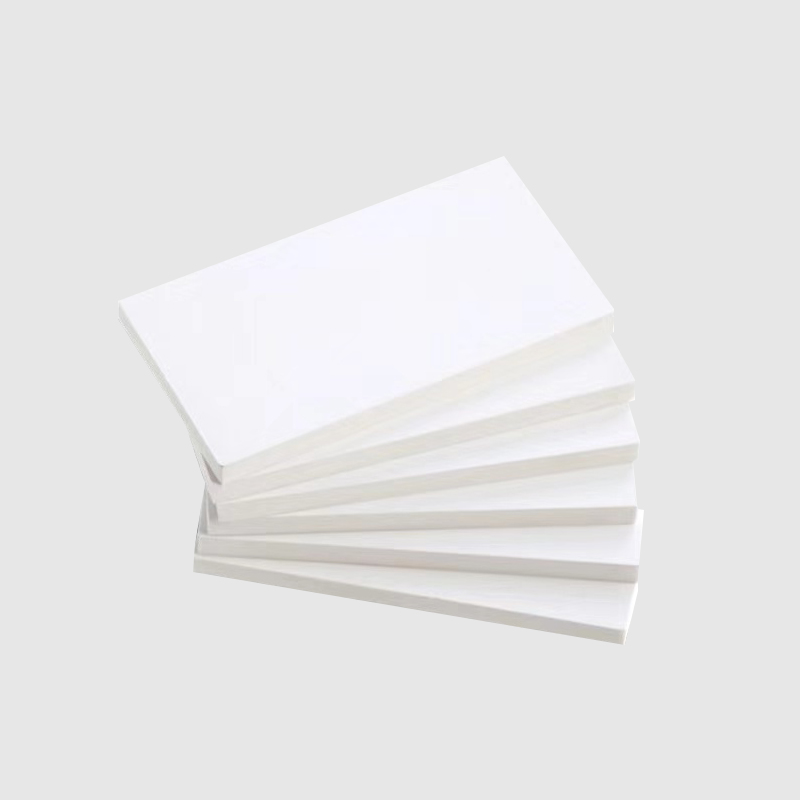 High-Density PVC Foam Board for Advertising and SignageThis Celuka extruded PVC foam board offers a smooth surface suitable for printing and laminating. Its high-density structure aids rigidity and flatness, making it a practical choice when evaluating board parameters for clean finished edges.View Product →
Surface Quality and Print Adhesion: What Specifiers Should Check
Surface finish decides how well ink bonds and how clean the finished edge looks.
Free-foam PVC has a micro-porous face that holds primer well. Coextruded and Celuka boards produce a smooth, dense cap layer that accepts UV-curable and solvent inks directly. The right board type depends on the print process and the expected service life.
| Board type | Surface structure | Typical density | Best use case |
| Free-foam | Micro-porous, slight texture | 0.40-0.60 g/cm3 | Short-term indoor signs |
| Coextruded | Smooth, dense cap layer | 0.55-0.75 g/cm3 | UV-printed point-of-purchase (POP) displays |
| Celuka | Hard integral skin, closed core | 0.65-0.90 g/cm3 | Outdoor signage and exhibition walls |
A surface tension of 38 dynes/cm or higher allows solvent and UV inks to be applied without primer. Below 34 dynes/cm, adhesion failure can appear within weeks. Coextruded and Celuka boards from Jiatao are engineered to hold stable surface tension across the full sheet.
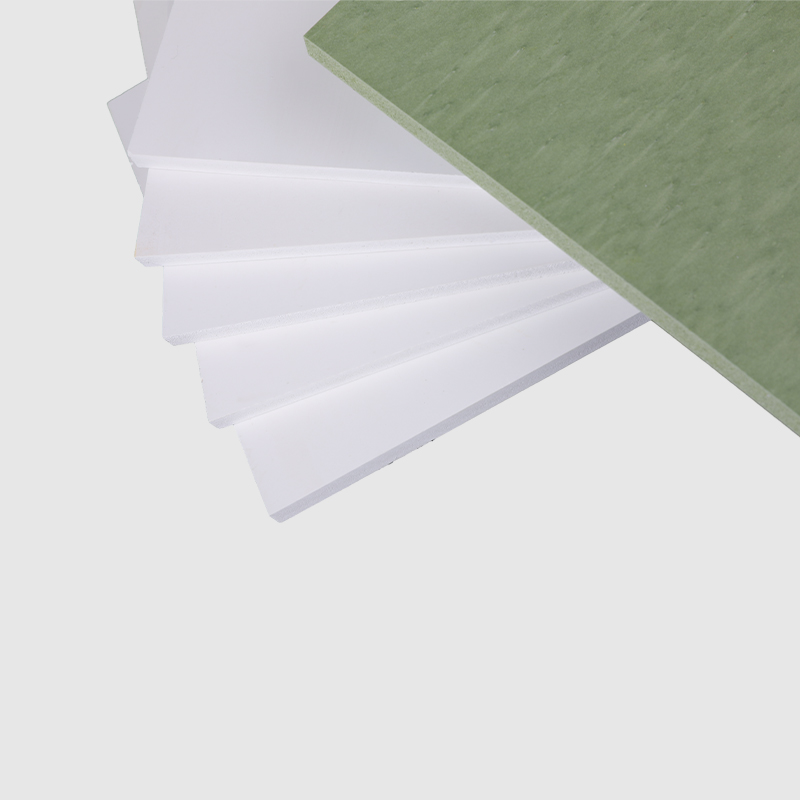 5mm UV Printing PVC Sintra Sheet for SignageThis sintra-grade board is engineered for UV flatbed printing with a smooth closed-cell surface that accepts UV and solvent inks without primer. It delivers dimensional stability for signboards and banners, relevant when large-format panels require reliable ink adhesion.View Product →
Thickness, Density, and Structural Rigidity for Large-Format Displays
For large-format panels, thickness and density matter more than surface appearance.
Thin boards are light and inexpensive, but flex across unsupported spans. Thick boards carry loads, hold fasteners, and route cleanly for dimensional lettering. Display fabricators usually keep both ranges in stock.
Thin range, 3-5mm
- Indoor POS and hanging signs
- Short-term promotional graphics
- Backed or framed mounting required
- Lowest material cost
Structural range, 10-19mm
- Outdoor signage and facade lettering
- Exhibition walls and booth structures
- Self-supporting with edge frames
- CNC-routed details hold sharp profiles
Selecting the right thickness depends on four factors:
- Wind load: freestanding outdoor signs need at least 12mm plus a stiffening frame
- Span: unsupported distances above 600mm require thicker or higher-density board
- Fastening method: flush-mounted panels need enough edge thickness for screws
- Routing depth: deep CNC details need at least 10mm to keep profile strength
Core fact
At 12mm thickness and 0.6-0.7 g/cm3 density, PVC foam board delivers the best stiffness-to-weight balance for exhibition display work. It is thick enough for flush-mounted edges and light enough for one-person handling.
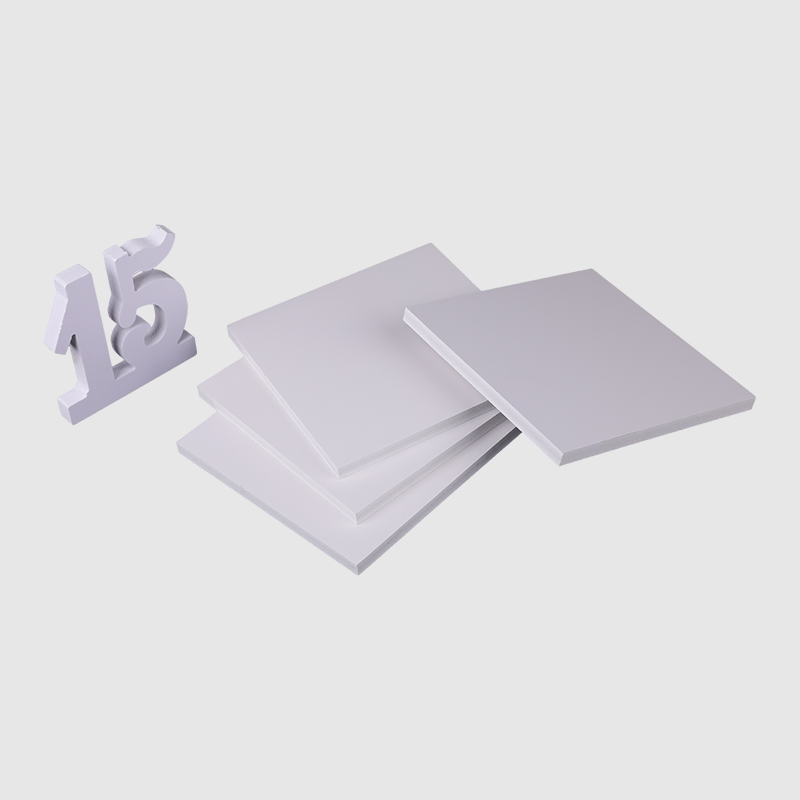 Eco-Friendly PVC Foam Display Board 9-12mmThis display board uses reduced-environmental-impact materials while offering thickness options around 9 to 12mm. Its closed-cell core resists moisture and the smooth surface accepts printing and laminating, making it a durable yet lightweight choice for retail and exhibition displays.View Product →
Weather Resistance and Long-Term Cost Performance
Weather resistance is a lifecycle cost issue, not just a material specification.
UV radiation, humidity cycles, and temperature swings degrade unprotected substrates. PVC foam board is inherently waterproof and, with UV stabilizers, resists yellowing far better than many commodity plastics. This extends the interval between sign replacements.
| Material | Weight per 4x8x10mm sheet | Moisture resistance | Fabrication ease | Relative cost |
| PVC foam board | ~15 kg | Excellent; closed cells absorb no water | CNC, saw, router, heat bend | Low |
| MDF | ~22 kg | Poor; edges swell | Easy but dusty | Very low |
| Plywood | ~16 kg | Moderate; delamination risk | Easy; splinters on cut edges | Low-medium |
| Acrylic sheet | ~35 kg | Good; can craze | Laser, edge polish required | High |
Five-year cost path for a 2.4 x 1.2 m outdoor sign: an MDF board needs edge sealing, repainting, and at least one replacement; a UV-stabilized PVC foam board stays in place for the full period. The PVC solution typically lands 30-40% lower in total cost before labor is counted. Field data appears in industrial reports on advertising and exhibition display materials.
Fabrication and Installation Advantages
Fast, predictable fabrication lowers installed cost.
PVC foam board can be cut, routed, heat-bent, bonded, and screwed using ordinary workshop equipment. Edges stay clean without lamination, and tool wear is lower than with wood composites or acrylic.
- CNC routing with 18,000-24,000 rpm and single-flute compression bits gives chip-free edges
- Carbide-tipped saw blades cut cleanly at moderate feed rates to prevent edge melting
- Heat bending at 140-160 degrees C produces curved display elements without cracking
- Structural acrylic or solvent-based adhesives bond sheets after isopropyl alcohol cleaning
- Pilot holes 1mm smaller than screw diameter prevent thread stripping in dense boards
Leave 2-3mm expansion clearance around large outdoor panels. Hard-mounting without clearance transfers thermal movement directly into the frame and can crack corners.
Frequently Asked Questions
Selection for signage and display work comes down to four questions: substrate density, surface tension, thickness, and the cost of failure.
How long do PVC foam board signs last outdoors?
With a UV-stabilized, lead-free formulation, a coextruded or Celuka-grade PVC foam board typically remains serviceable for 5 to 10 years outdoors. Free-foam boards in the 0.40-0.50 g/cm3 range are better suited for indoor or short-term outdoor use unless painted or laminated.
Can PVC foam boards be used in high-humidity environments?
Yes. The closed-cell structure absorbs virtually no water, which is why the material is widely used for bathroom cabinetry and exterior cladding. Humidity below 90% RH has minimal measurable effect on dimensional stability.
What thickness should I choose for a large-format display?
For a standard 1220 x 2440mm exhibition panel, start at 10mm. Move to 12-19mm for self-supporting outdoor structures, and use 5mm or less only for framed or fully backed indoor graphics.
Is PVC foam board compatible with modern procurement requirements?
Jiatao's production is lead-free, and several board lines are recyclable. The company also offers virgin-material print-grade options, which reduce contamination risk during recycling and support cleaner material streams.
When you specify boards for a signage line or a display project, ask the supplier for density curves, surface tension readings, and weathering data before placing a bulk order.
Signage and display quality is decided long before the ink dries. A flat, waterproof, printable substrate cuts fabrication time, simplifies installation, and keeps graphics looking correct for years.
PVC foam boards from Jiatao Industrial Co., Ltd. are produced in thicknesses from 3mm to 330mm, with customized dimensions, color, density, and surface finish available on request.
Recommended NEWS:
PVC Free Foam Board's multiple applications and environmental advantages in the field of transportation
Application of White High-Tech PVC Plastic Foam Sheets in Advertising and Exhibition Display
How to choose the right Laminated PVC foam board according to the surface treatment and lamination type
How to ensure the installation quality of PVC Ceiling Panel
Laminated PVC Foam Board has the advantages of being moisture-proof and water-resistant compared to other materials
How does the density range of pvc foam board celuka forex plastic sheets affect the strength, rigidity and thermal insulation performance of the board?
Related Products

Jiatao Industry Co., Ltd. is a professional manufacturer of polyvinyl chloride plastic boards in China, dedicated to the production of PVC foam boards, plastic wood foamboards, as well as colorful pVC for extruded foam board sheet manufacturers.
-
ADDRESS
No.65 Liminba, Yinong Town, Xiaoshan District, Hangzhou, Zhejiang, China
-
EMAIL
-
PHONE
+86-17816178586
MOBILE SITE



Copyright © Jiatao Industry Co., Ltd. All Rights Reserved.
Custom Rigid PVC Plastic Foam Boards Suppliers

Contact Us