

 English
 Español
 عربى

Home / News / Industry News / How to Choose the Right PVC Foam Board for Different Industrial Applications
How to Choose the Right PVC Foam Board for Different Industrial Applications
Article Directory
- 1 Understand the three board families before you compare prices
- 2 Match density to mechanical load
- 3 Choose the surface finish for printing and lamination
- 4 Select thickness by span and support
- 5 Evaluate moisture, fire, and UV requirements
- 6 Qualify suppliers with samples and process audits
- 7 Frequently asked questions
Two buyers ask for PVC foam board at the same trade fair and leave with completely different materials. The signmaker needs a 5 mm sheet with clean ink adhesion for flatbed UV printing; the cabinet manufacturer needs an 18 mm panel with screw-holding strength and a moisture-proof surface. Choosing by price alone produces warped panels, blistered prints, and stripped fasteners. The selection criteria that matter in industrial purchasing are board family, density, surface finish, thickness, and environmental resistance.
Understand the three board families before you compare prices
PVC foam board is a process-defined family, not a single product, and the manufacturing route sets the mechanical and surface properties you can actually specify.
PVC foam board is a rigid cellular sheet produced by extruding polyvinyl chloride resin with a blowing agent; the density and skin structure formed during extrusion control stiffness, surface hardness, and moisture resistance.
Three processes dominate industrial supply. Free-foam board forms a soft, low-density skin across the whole surface. Celuka board creates a dense outer skin over a foamed core. Co-extruded board fuses a solid PVC cap layer to the core, giving the smoothest and least porous face. The choice determines print quality, edge finishing, and moisture behavior.
- Free-foam board: light and economical, with a practical thickness range of 3-330 mm; suited to signage, display graphics, and architectural models.
- Celuka board: hard surface over a foamed core, with clean CNC edges; suited to furniture panels, routed lettering, and cabinet doors.
- Co-extruded board: solid cap over a closed-cell core with low water absorption; suited to UV printing, lamination, kitchen and bathroom cabinets, and transport interiors.
| Manufacturing route | Skin structure | Typical density (g/cm3) | Best-fit applications |
| Free foam | Soft low-density skin | 0.40-0.55 | Signage, display, model making |
| Celuka | Dense hard skin over foam core | 0.55-0.80 | Furniture, CNC routing, cabinetry |
| Co-extruded | Solid cap layer over foam core | 0.55-0.90 | UV printing, kitchen and bathroom cabinets, transport interiors |
Rule of thumb: where the face is printed or visible, choose co-extruded; where edges are machined and rigidity matters, choose Celuka; where cost and weight lead and the part is temporary, free-foam board is sufficient.
Match density to mechanical load
Density is the most reliable predictor of mechanical performance, so specify a minimum density value instead of relying on thickness alone.
- 0.40-0.50 g/cm3: temporary signage, exhibition graphics, and architectural models; treat the board as non-structural.
- 0.55-0.65 g/cm3: flatbed UV printing, display counters, and wall cladding with full backing support.
- 0.65-0.80 g/cm3: cabinet bodies, doors, shelving, and racking where screw-holding and edge impact resistance matter.
- Above 0.80 g/cm3: industrial enclosures, work surfaces, heavy fixtures, and automotive interior support panels.
At 0.65 g/cm3 and above, screw pull-out resistance and edge impact strength cross the practical threshold for load-bearing furniture. Below 0.5 g/cm3, design the panel as a decorative skin, not a structural member.
Higher density also improves vibration damping and dimensional stability. In partition systems and vehicle interiors, a 0.7 g/cm3 Celuka or co-extruded board holds screw fixings and resists creep far better than a 0.5 g/cm3 free-foam sheet.
Choose the surface finish for printing and lamination
The surface skin controls ink adhesion, lamination bond strength, and long-term appearance, so it must be specified before you compare price lists.
For UV printing, surface tension should reach at least 38 dyne/cm; co-extruded boards hold this level across the full sheet, while free-foam skin can develop pinholes and absorb ink unevenly. For CNC routing and V-grooving, the dense Celuka skin produces clean edges without fuzz. For cabinetry, the solid cap of a co-extruded panel also blocks moisture at cut edges and hinge holes. This relationship between skin structure and machining behavior is examined in our note on co-extruded surface hardness in cabinetry.
The 38 dyne/cm baseline separates printable grades from general-purpose boards. Below this level, UV ink beads on the surface and fails a cross-hatch adhesion test within 24 hours.
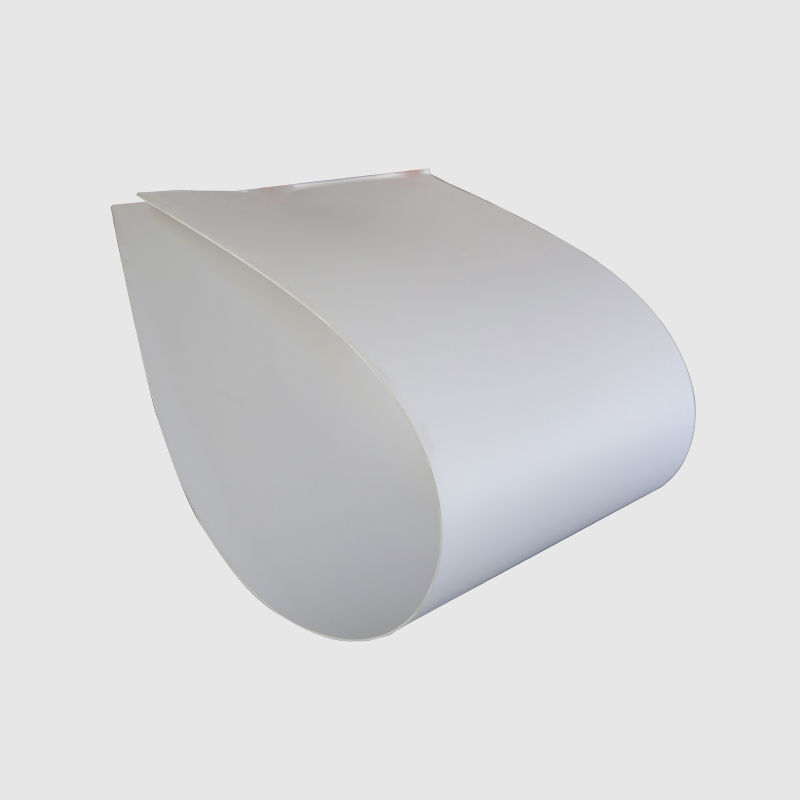 PVC Co-extruded Foam Board for Cabinetry and Furniture, 3-18 mmThis board combines a dense Celuka skin with moisture resistance and dimensional stability, making it suitable for cabinet doors, panels, and CNC processing where clean edges and humidity performance matter.View Product →
Select thickness by span and support
Thickness is a span-and-deflection decision: a 3 mm sheet bows noticeably at a 600 mm unsupported span, while an 18 mm panel carries 40-60 kg shelf loads without visible sag.
Recommended thickness ranges by application
Signage
3-10 mm
Display
5-12 mm
Wall panels
8-15 mm
Cabinetry
12-25 mm
Heavy parts
25-330 mm
At 3-5 mm, boards act as printable skins for framed signage; at 8-12 mm they stand alone as display panels; at 15-25 mm they replace plywood in cabinet construction; at 30 mm and above they become machinable blocks for enclosures, work surfaces, and specialty components. A deeper look at durable thickness grades helps align panel dimension with expected service life.
Never specify thickness without knowing the support spacing. A 9 mm board feels rigid at 400 mm centers and visibly flexible at 800 mm centers. State the frame pitch in the procurement document.
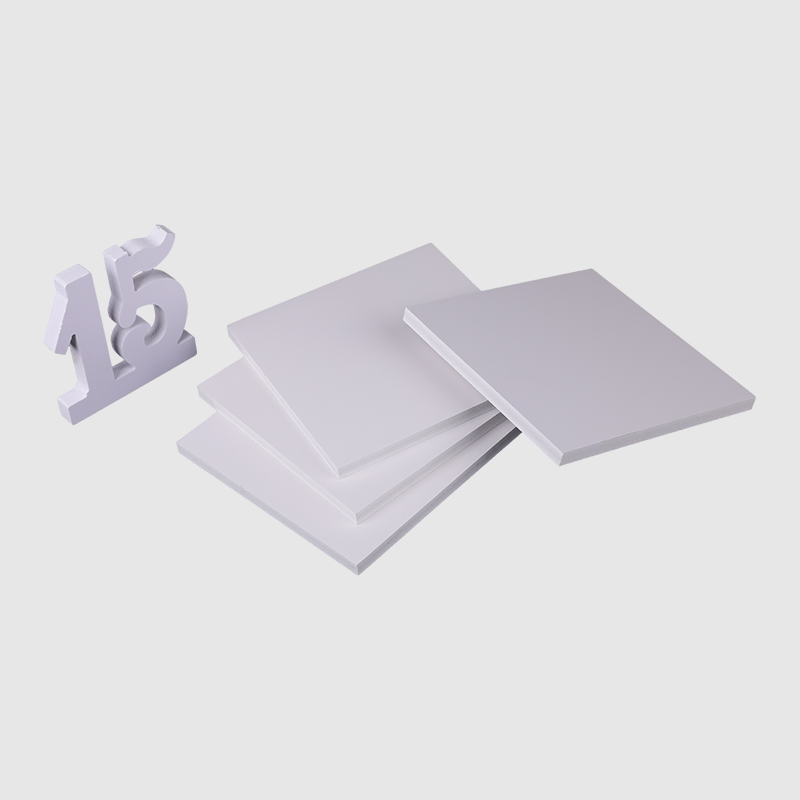 Eco-friendly PVC Foam Display Board, 9-12 mm ThicknessDesigned for retail and exhibition displays, this lightweight yet rigid board offers a smooth printable surface, moisture resistance, and custom color options, fitting framing or freestanding signage applications.View Product →
Evaluate moisture, fire, and UV requirements
Environmental resistance is decided by skin density and additive package, so set water absorption, fire rating, and UV stability as pass/fail criteria rather than marketing adjectives.
- Moisture: closed-cell structure with water absorption below 0.5% is mandatory for kitchen and bathroom cabinetry; co-extruded and WPC grades pass, standard free foam does not.
- Fire: for commercial interiors, request documented flame-spread index and smoke-developed index values or a UL94 class; lead-free and REACH compliance are required for European and North American projects.
- UV: outdoor signage requires a UV-stable cap layer; uncoated free-foam surfaces yellow and chalk within 6-12 months of direct sun exposure.
In wet zones, co-extruded and WPC foam boards outperform plywood and free-foam sheet because their closed-cell structure blocks capillary water migration at cut edges and fastener holes.
 UV-Coated PVC Light Grain Wall Panel, 15 mm ThickWith a realistic wood-grain finish and UV protective coating, this wall panel resists fading, moisture, and scratches, offering easy tongue-and-groove installation for interior decoration in humid spaces.View Product →
Qualify suppliers with samples and process audits
A reliable industrial supplier proves consistency in density, thickness tolerance, and surface quality, and backs it with test reports and pilot batches instead of a glossy datasheet.
- Request batch-to-batch density certificates when boards will be printed or CNC machined.
- Verify thickness tolerance: +/- 0.2 mm for panels under 20 mm is achievable from a controlled extrusion line.
- Inspect flatness: a standard 2440 mm board should lie flat within 2-3 mm without forced flattening.
- Confirm certification: SGS reports, lead-free statements, REACH declarations, and fire-test documentation where required.
- Run a pilot order before volume commitment, and test routing, printing, and edge finishing in your own process.
25,000+Tons annual capacity
15+Years of experience
11,000m2 facility
1,000+Project cases
Jiatao Industrial Co., Ltd. is a specialized PVC foam board manufacturer with an 11,000 m2 facility, annual capacity above 25,000 tons, and more than 15 years of experience. Its free-foam, Celuka, co-extruded, colored, WPC, and laminated wall panel products export to the United States, Germany, Japan, Spain, Italy, the United Kingdom, South Korea, Australia, and Canada, with custom thickness, density, color, and surface treatment programs for industrial buyers.
For OEM and trade buyers, request a pre-production sample in the target thickness and color, then verify flatness, density, and print adhesion against the agreed specification before releasing a serial order.
Frequently asked questions
What density of PVC foam board is best for cabinet doors?
Specify co-extruded or Celuka board at 0.65-0.80 g/cm3 in 15-18 mm thickness. The dense skin accepts hinges and screws without stripping, and the closed-cell core resists kitchen moisture.
Is PVC foam board waterproof?
All PVC foam boards resist water on the face, but only closed-cell grades such as co-extruded and high-density Celuka keep moisture out at cut edges and fastener holes. For bathroom or outdoor installations, set a water absorption limit below 0.5%.
Can PVC foam board be used outdoors?
Yes, with limits. Co-extruded and UV-stable grades survive outdoor signage for several years; standard free-foam boards yellow and become brittle within 6-12 months of direct sunlight. Confirm the cap layer composition before specifying outdoor use.
What is the difference between free-foam and Celuka board?
Free-foam board has a soft, low-density skin across the entire surface; Celuka board forms a hard outer skin over a foamed core in the cooling die. Celuka is harder, stiffer, and more expensive, and it produces cleaner CNC edges than free foam.
Recommended NEWS:
How to deal with board deformation during the production process of PVC Celuka Board?
How does PVC co-extruded foam board provide excellent waterproof performance to ensure the service life of furniture?
How to choose the right Laminated PVC foam board according to the surface treatment and lamination type
PVC Free Foam Board's multiple applications and environmental advantages in the field of transportation
Custom Laminated PVC Foam Board: A versatile material with excellent waterproof performance
How to ensure the installation quality of PVC Ceiling Panel
Related Products



Jiatao Industry Co., Ltd. is a professional manufacturer of polyvinyl chloride plastic boards in China, dedicated to the production of PVC foam boards, plastic wood foamboards, as well as colorful pVC for extruded foam board sheet manufacturers.
-
ADDRESS
No.65 Liminba, Yinong Town, Xiaoshan District, Hangzhou, Zhejiang, China
-
EMAIL
-
PHONE
+86-17816178586
MOBILE SITE



Copyright © Jiatao Industry Co., Ltd. All Rights Reserved.
Custom Rigid PVC Plastic Foam Boards Suppliers

Contact Us