

 English
 Español
 عربى

Home / News / Industry News / Sourcing PVC Foam Boards for Furniture Manufacturing: 6 Key Factors to Check
Sourcing PVC Foam Boards for Furniture Manufacturing: 6 Key Factors to Check
Article Directory
- 1 Density Is the First Screening Filter
- 2 Cell Structure and Process Route Decide Screw Holding
- 3 Thickness Tolerance and Dimensional Stability in a Real Workshop
- 4 Surface Hardness, Screw Holding and Machining Behaviour
- 5 Fire, Lead and Chemical Compliance Paperwork
- 6 Supplier Verification, Minimum Order and Landed Cost
- 7 Practical Answers Before You Place the Order
A 1220 x 2440 mm sheet of 18 mm PVC foam board at 600 kg/m3 weighs 32.1 kg. Cut the same panel from 18 mm MDF at 750 kg/m3 and it weighs 40.2 kg. On a cabinet line running 400 door panels a day, that 8.1 kg gap per panel changes hinge loading, container planning and how long an operator can hold a panel on the assembly bench.
32.1 kg18 mm PVC foam board at 600 kg/m3, 1220 x 2440 mm
40.2 kg18 mm MDF at 750 kg/m3, identical panel size
20 %Less weight carried per finished door panel
That arithmetic is why furniture manufacturers do not source PVC foam board on price per sheet alone. The board still has to take a screw, survive a CNC router, accept an edge band and clear a flammability test in the destination market.
Six factors decide whether a supplier's sheet survives your production run: density, cell structure and process route, thickness tolerance, surface and machining behaviour, compliance documentation, and process control on the extrusion line. Each one can be verified before the container leaves the port.
Density Is the First Screening Filter
Specify 600 kg/m3 or above for structural furniture parts and 450 to 550 kg/m3 for non-load-bearing panels. Density is measured to ISO 1183 and should be declared with a tolerance no wider than plus or minus 5 percent.
Density sets stiffness, screw pull-out and edge integrity at the same time. An 18 mm sheet at 450 kg/m3 weighs 24.1 kg, eight kilograms lighter than the 600 kg/m3 board above, and that saving comes straight out of the material's ability to carry a hinge plate. Free-foam sheet can also drift 8 to 10 percent between the centre and the edge of the same panel, so a datasheet figure is nominal until it is measured per batch.
Typical density bands by board type (kg/m3)
Bars are scaled against a common 800 kg/m3 axis. Ranges are typical published figures; confirm them against the supplier's per-batch records.
A supplier who quotes thickness and colour but never density in kg/m3 is selling an appearance, not a specification.
Cell Structure and Process Route Decide Screw Holding
Co-extruded and Celuka crust boards hold fasteners measurably better than free-foam sheet at the same nominal density, because the extrusion route controls where the density sits across the cross-section.
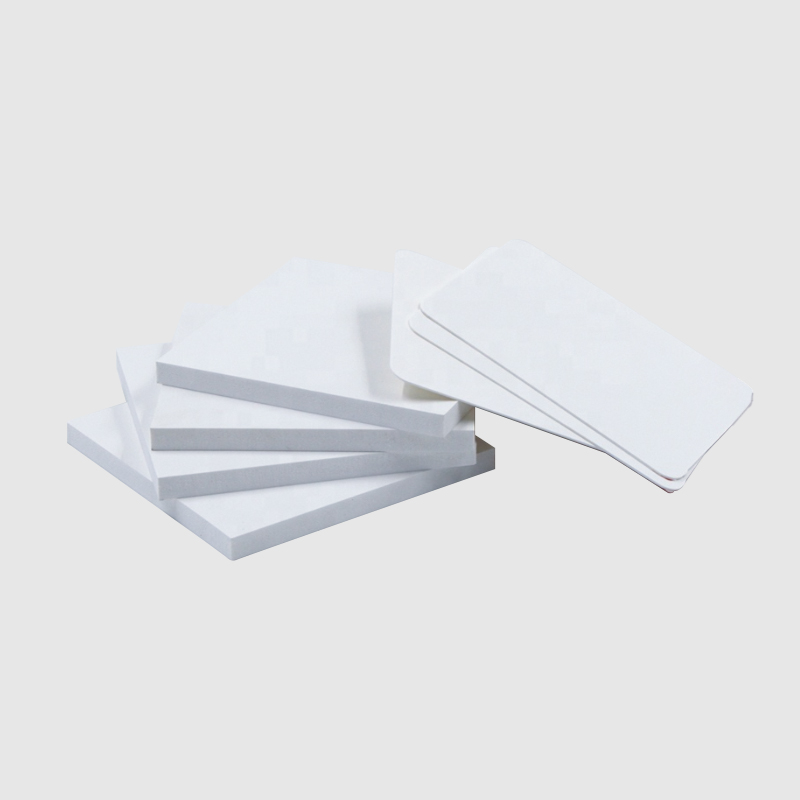
PVC foam board, sold internationally as Forex, Sintra, Sunboard or Celuka sheet, is a rigid closed-cell extruded panel made from polyvinyl chloride resin. Density normally runs from 350 to 800 kg/m3 and thickness from 1 mm to 330 mm; the trade names describe process lineage and surface finish, not a specification.
Free foam
Free-foam sheet expands as it leaves the die, so cell size is uniform through the thickness and the face stays soft. It is the cheapest route and the right choice for signage and non-structural infill, and the wrong choice for a door that will be opened 20,000 times.
Celuka crust foam
Celuka board is extruded against a cooled calibrator that skins the surface while the core foams, producing a dense crust over a lighter core at 550 to 650 kg/m3 overall. The face is hard enough to take a screw or a laminate without a substrate.
Co-extruded foam
Two extruders feed one die: a skin compound formulated for hardness, print quality and UV stability, and a core compound formulated for low weight. Boards from 3 mm to 18 mm cover carcasses, doors and drawer fronts.
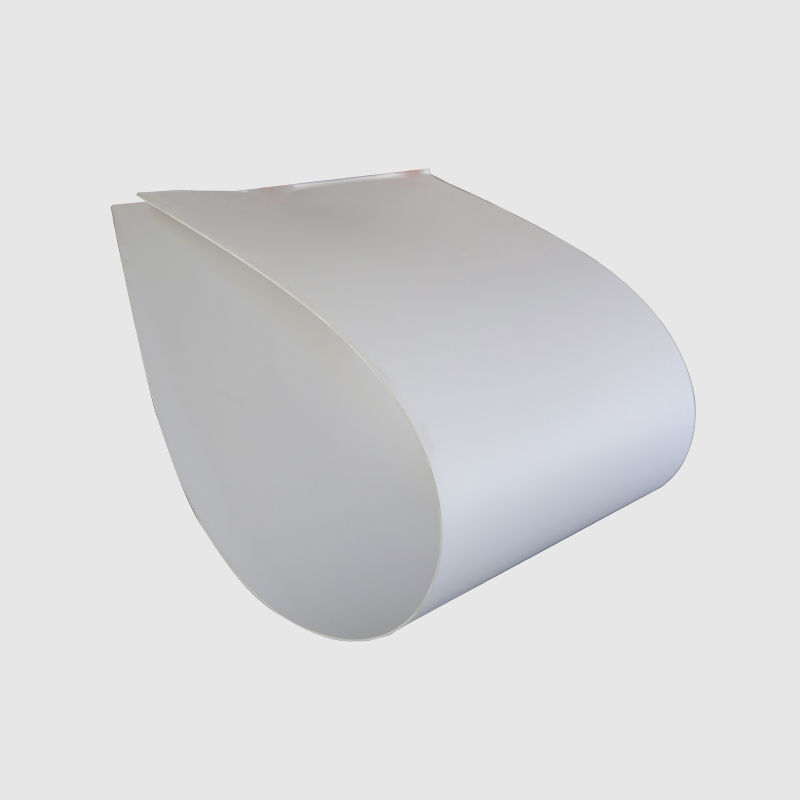 Co-Extruded PVC Foam Board for Cabinets and FurniturePVC co-extruded foam board in 3–18 mm, with skin/core construction for cabinet carcasses, doors, drawer fronts, and interior furniture panels.View Product →
Free foam
- Soft, matte face
- Uniform cell structure
- Lowest cost per sheet
Celuka or co-extruded
- Dense skin, hard face
- Higher screw pull-out
- Cleaner routed edges
| Board type | Typical density (kg/m3) | Face | Typical thickness | Furniture use |
| Free foam | 400-550 | Soft, matte | 1-30 mm | Back panels, non-structural infill |
| Celuka crust | 550-650 | Hard skin | 3-20 mm | Cabinet doors, drawer fronts |
| WPC foam | 500-700 | Wood-like, matte | 2-18 mm | Bathroom cabinets, wall panels |
| Co-extruded | 550-750 | Smooth, hard | 3-18 mm | Carcasses, doors, printed fronts |
Suppliers who document these differences in furniture terms publish selection notes; how Celuka foam board performs in furniture manufacturing sets out a worked comparison of the three routes.
Thickness Tolerance and Dimensional Stability in a Real Workshop
Buy plus or minus 0.2 mm on panels under 20 mm. A stack that varies by 0.5 mm produces inconsistent CNC nesting depth and a visible step where the edge band meets an 18 mm door, even when the toolpath is correct.
PVC foam board moves with temperature before it moves with anything else. The coefficient of linear thermal expansion for rigid PVC is about 0.07 mm per metre per degree Celsius, so a 2440 mm panel travelling from a 15 C warehouse to a 30 C workshop grows roughly 2.6 mm, which is enough to bind in a feed rail. Water absorption stays below 0.5 percent after 24 hours of immersion to ISO 62, while MDF can swell 8 to 15 percent and never recover. That single property is why bathroom and kitchen carcasses move to foam board first.
- Measure five sheets drawn from different positions in the stack, not five from the top pallet.
- Check thickness at nine points per sheet, including both long edges and the centre.
- Lay each sheet on a flat table and record bow and twist; more than 2 mm over 1 m will show in a glued joint.
- Record the batch code from the pallet label and keep it with the test report.
Thickness tolerance belongs on the purchase order, not in a brochure. Write plus or minus 0.2 mm, name the measuring instrument and state where on the sheet the reading is taken.
Surface Hardness, Screw Holding and Machining Behaviour
Ask for pull-out test data instead of adjectives. Datasheets for co-extruded sheet at 600 to 650 kg/m3 commonly quote 900 to 1,100 N with a 4 x 40 mm screw, against roughly 600 to 700 N for free foam at the same density; request the test method and the panel density next to the figure.
Face hardness on furniture-grade crust board usually falls in the Shore D 45 to 60 band, which is what keeps a 0.5 mm laminate or a direct-print UV layer flat on a door. Below that band the face marks during sanding and the printed image telegraphs the cell structure underneath.
Machining and finishing settings that hold up
- Cut 18 mm co-extruded sheet with a 6 mm two-flute compression bit at 18,000 rpm and 3 to 4 m/min feed; slow the feed and the surface melts rather than cuts.
- Treat the face to a dyne level of 38 to 42 mN/m before UV printing; below 38 mN/m, ink adhesion fails a cross-hatch tape test within a week.
- Counterbore rather than over-tighten; a 4 mm screw driven past the crust into the foam core loses most of its pull-out value.
- Bond with a solvent-free PU or epoxy system and clamp for 30 minutes; solvent cements attack cell walls and leave a visible sink line.
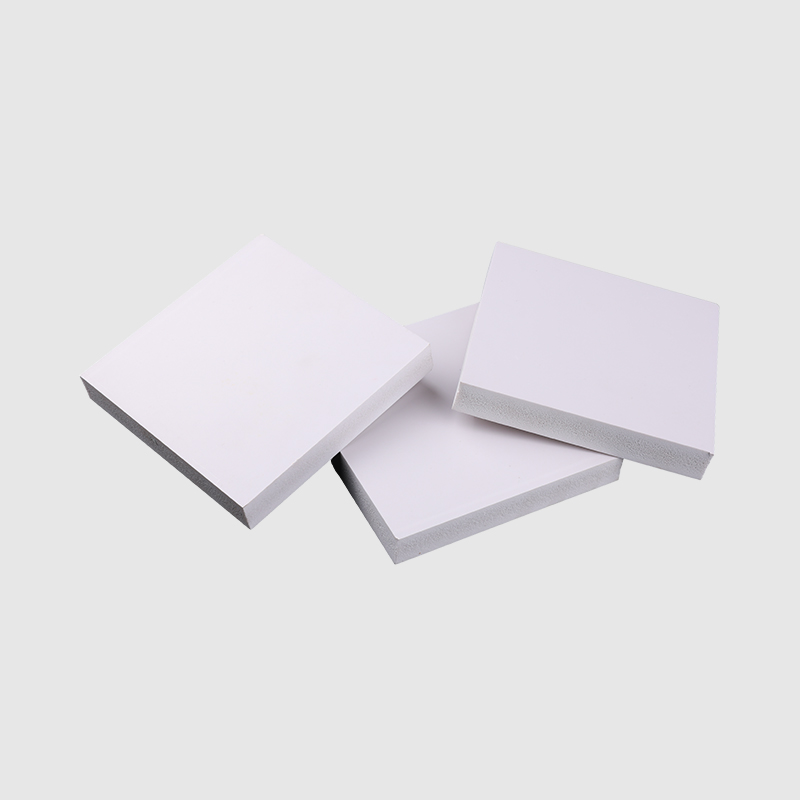 Glossy 18mm PVC Embossed Foam Board for FurnitureRigid 18 mm white PVC foam board with high-gloss embossed face, waterproof MDF/plywood alternative for cabinetry, wardrobes, and office furniture.View Product →
Two numbers separate furniture-grade board from display-grade board: pull-out force in newtons and face hardness in Shore D. Neither appears on a colour chart.
Fire, Lead and Chemical Compliance Paperwork
Two documents delay PVC foam board shipments more often than any other: a class B fire test report and a lead-free declaration. Rigid PVC contains roughly 57 percent chlorine by weight and resists ignition without additives, but that chemistry is not a certificate.
For interior wall and ceiling panels in the European Union the reference is EN 13501-1 class B-s1,d0; in the United States it is ASTM E84 Class A. On the chemical side, RoHS restricts lead in plastics to 0.1 percent, or 1,000 ppm, by weight, and the ECHA SVHC candidate list under REACH is revised twice a year, so the revision date on a report matters as much as the result. PVC foam board contains no formaldehyde, whereas MDF is capped at 0.124 mg/m3 under the E1 chamber limit.
Insist that the report names density, colour and batch. A certificate issued for a 3 mm white sheet proves nothing about an 18 mm black sheet from a different extrusion run.
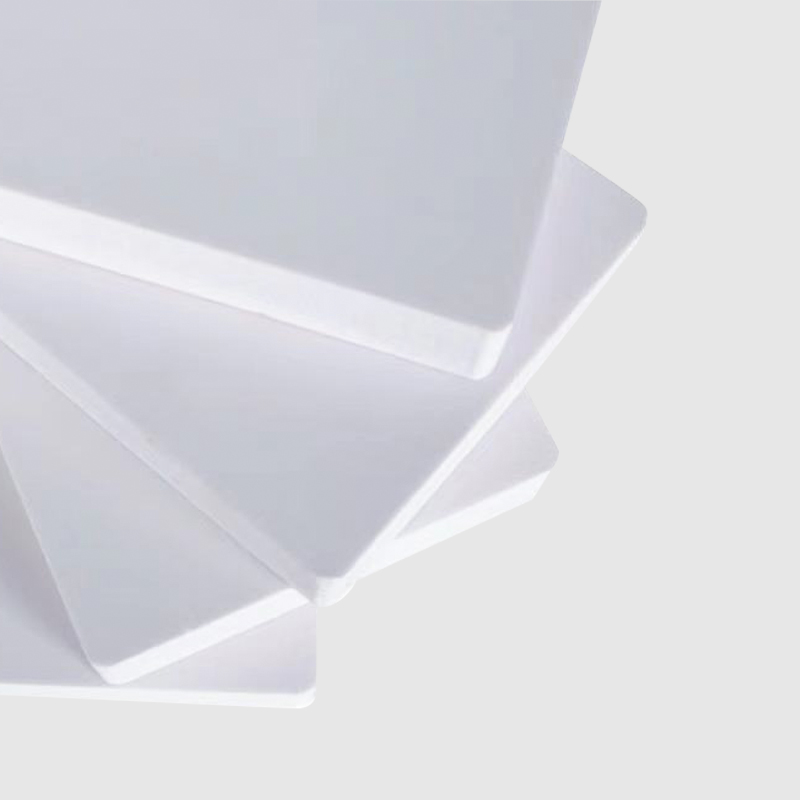 White PVC Foam Boards for Furniture, 11mm to 18mmWhite PVC foam panels in 11, 15, and 18 mm, described as moisture- and fire-resistant for indoor or outdoor furniture and custom designs.View Product →
Compliance is a document trail, not a product feature. If the certificate carries no batch number, purchase order or density, it will not survive a customer audit.
Supplier Verification, Minimum Order and Landed Cost
Verify three things before the first container ships: batch density records, the cooling and calibration section of the extrusion line, and a third-party report that names your batch. Everything else is negotiable.
Cooling and calibration control skin thickness. A line that lifts output by speeding up the haul-off produces internal voids and a thin crust that fails at the screw hole three months after the cabinets are installed, long after the invoice is paid. Ask for the calibration setting and the haul-off speed range for the thickness you are buying.
Freight is the second cost driver. PVC foam board is light and bulky, so containers cube out before they weigh out; a 40 ft high-cube load is governed by sheets per pallet and pallets per container rather than by tonnage. Ask for the loading plan in writing with the quotation.
A serious order starts with a supplier that publishes density and thickness tolerance per SKU rather than one range for the whole catalogue; a PVC foam board manufacturer working this way will supply a pre-shipment sample cut from the production batch.
Process control beats promises. Ask for the haul-off speed, the calibration setting and the density record for the exact thickness you are ordering, dated within the last 30 days.
Practical Answers Before You Place the Order
Which density suits kitchen cabinet doors?
Use 600 to 650 kg/m3 in 18 mm, in a Celuka or co-extruded board. At that density a 1220 x 2440 mm panel weighs 32 to 35 kg and takes a standard 4 x 40 mm screw without a reinforcement plate.
Can PVC foam board replace MDF in furniture?
Yes for wet areas, doors, drawer fronts and any panel where weight matters. No for structural spans above 1.5 m without reinforcement, because the foam core has a lower modulus than MDF at comparable thickness.
How should thickness tolerance be written on a purchase order?
State plus or minus 0.2 mm for boards under 20 mm and plus or minus 1 percent above 20 mm, name the measuring instrument and specify nine measurement points per sheet.
How is density verified before shipping?
Weigh and measure five sheets per batch and divide mass by volume; the result must fall within plus or minus 5 percent of nominal to ISO 1183. Ask the supplier to attach those five readings to the packing list.
Four questions, four written answers. A supplier who replies to all four with data rather than adjectives has already passed the first audit.
Recommended NEWS:
Fireproofing of Custom Laminated PVC Foam Boards
Custom Laminated PVC Foam Board: A versatile material with excellent waterproof performance
How to deal with board deformation during the production process of PVC Celuka Board?
Laminated PVC Foam Board has the advantages of being moisture-proof and water-resistant compared to other materials
White Laminated PVC Free Foam Boards: Environmentally friendly and sustainable production
PVC cellular board Suppliers quality inspection: ensure the comprehensive guarantee of product performance
Related Products


Jiatao Industry Co., Ltd. is a professional manufacturer of polyvinyl chloride plastic boards in China, dedicated to the production of PVC foam boards, plastic wood foamboards, as well as colorful pVC for extruded foam board sheet manufacturers.
-
ADDRESS
No.65 Liminba, Yinong Town, Xiaoshan District, Hangzhou, Zhejiang, China
-
EMAIL
-
PHONE
+86-17816178586
MOBILE SITE



Copyright © Jiatao Industry Co., Ltd. All Rights Reserved.
Custom Rigid PVC Plastic Foam Boards Suppliers

Contact Us