

 English
 Español
 عربى
عربى
PVC Cellular Foam Board: Waterproof, Uses & Composition
Article Directory
- 1 Everything You Need to Know About PVC Cellular Foam Board
- 2 Why PVC Foam Is Genuinely Waterproof
- 3 What Conditions PVC Foam Board Can Handle
- 4 Ingredient Breakdown of PVC Foam Board
- 5 Free Foam vs Celuka: Two Manufacturing Processes
- 6 PVC Foam Board Grades and Physical Properties
- 7 Signage and Visual Display
- 8 Construction and Architectural Trim
- 9 Marine and Wet-Environment Fittings
- 10 Furniture and Interior Fit-Out
- 11 Industrial and Engineering Applications
- 12 PVC Foam Board vs Competing Materials: Application Match
- 13 PVC Cellular Foam Board: The Right Choice When Moisture, Weight, and Longevity All Matter
Can PVC Board Get Wet?
PVC cellular foam board does not absorb water. Unlike wood, MDF, or plywood — which swell, warp, and delaminate when exposed to moisture — PVC foam board has a closed-cell structure that physically prevents water from entering the material. It can be submerged, rained on, and used in permanently humid environments without any dimensional change or structural degradation.
Why PVC Foam Is Genuinely Waterproof
The waterproof performance of PVC foam board comes from two sources working together. First, PVC (polyvinyl chloride) is inherently hydrophobic — its polymer chains have no affinity for water molecules. Second, the cellular foam structure is closed-cell: each microscopic air bubble is fully enclosed by solid PVC walls with no interconnecting channels through which water could travel.
Independent laboratory testing confirms water absorption of less than 0.5% by weight after 24-hour immersion for standard-density boards, and effectively 0% for Celuka-process boards with their dense outer skin. Compare this to standard plywood, which can absorb 15–30% of its weight in water during the same test, leading to thickness swelling of 10–15% and permanent delamination of surface veneers.
Material
24-hr Water Absorption
Thickness Swell
Outdoor Suitability
PVC Foam Board
Under 0.5%
0%
Excellent
MDF
20–40%
8–15%
None — degrades rapidly
Plywood (standard)
15–30%
10–15%
Limited — needs sealing
Solid Pine
10–20%
5–10%
Moderate — requires treatment
Foam PVC (Celuka)
<0.1%
0%
Outstanding — marine use rated
What Conditions PVC Foam Board Can Handle
Beyond simple wetness, PVC foam board withstands a range of challenging conditions that would quickly degrade wood-based alternatives. Understanding these limits is important for specifying the right product for long-term installations.
Rain and Standing Water
Full exposure — no protective coating required. Cut edges are equally waterproof because the closed-cell interior is identical to the surface.
Saltwater and Marine Environments
PVC is highly resistant to salt corrosion and chloride ions. Used extensively in boat interiors, dock signage, and coastal construction where salt spray is constant.
High Humidity (Bathrooms, Kitchens)
Zero moisture absorption means no mold growth on the board material itself. Suitable for bathroom cabinetry, wet room wall panels, and commercial kitchen fixtures.
Chemical Exposure
Resistant to most mild acids, alkalis, and cleaning agents. Not resistant to ketones, strong solvents (THF, MEK), or aromatic hydrocarbons — these will attack the PVC matrix.
What Is PVC Foam Board Made Of?
PVC cellular foam board is manufactured from polyvinyl chloride resin as the base polymer, combined with chemical foaming agents that generate gas bubbles during extrusion, and a range of additives that control density, surface quality, UV resistance, and processing behavior. The exact formula varies by manufacturer and application grade, but the core chemistry is consistent across the industry.
Ingredient Breakdown of PVC Foam Board
40–60%
PVC Resin
Base polymer — provides structural integrity, chemical resistance, and flame retardancy
15–30%
Calcium Carbonate / Fillers
Increases rigidity, reduces cost, controls expansion rate during foaming
5–10%
Stabilizers
Calcium-zinc or tin-based; prevent PVC degradation during high-temperature extrusion
2–5%
Foaming Agents
Decompose at extrusion temp to release CO2 or N2 gas — creates the cellular structure
1–3%
Modifiers
Impact modifiers, UV stabilizers, lubricants, and colorants
Free Foam vs Celuka: Two Manufacturing Processes
The two dominant manufacturing methods for PVC cellular foam board produce different surface and structural characteristics. Choosing between them depends on whether the application prioritizes lightweight flexibility or surface hardness and printability.
Free Foam Process
StructureUniform foam throughout the full thickness; no distinct skin
Density0.45–0.65 g/cm³ — lighter boards
SurfaceSlightly textured; good for painting but less ideal for direct digital print
MachinabilityEasy to cut, route, and screw — foam structure reduces tool resistance
Typical UseGeneral signage, display boards, lightweight partition panels
Celuka Process
StructureDense solid outer skin over foam core — sandwich-like cross section
Density0.65–0.90 g/cm³ — heavier, more structural
SurfaceSmooth, hard, glass-like finish — excellent for UV printing and lamination
MachinabilityMachines like hardwood — can be milled, shaped, and edge-finished to precision
Typical UseFurniture, architectural trim, outdoor displays, marine fittings
PVC Foam Board Grades and Physical Properties
| Grade | Density (g/cm³) | Flexural Strength (MPa) | Heat Deflection (°C) | Best Application |
| Low Density (LD) | 0.40–0.55 | 8–14 | 60–65 | Indoor display, lightweight panels |
| Standard (SD) | 0.55–0.70 | 14–22 | 65–70 | General signage, interior fit-out |
| High Density (HD) | 0.70–0.85 | 22–35 | 70–75 | Outdoor signage, furniture, marine |
| Celuka Hard Skin | 0.80–0.90 | 30–48 | 72–78 | Precision machining, architectural trim |
What Is PVC Foam Used For?
The combination of waterproofing, light weight, machinability, and surface printability makes PVC cellular foam board one of the most versatile sheet materials in commercial and industrial use today. Its applications span seven distinct sectors, each leveraging a different subset of its material properties.
Signage and Visual Display
Signage is the largest single application segment for PVC foam board globally. The material is lightweight enough to mount on walls and ceilings without heavy fixings, stiff enough to remain flat over large print areas, and smooth enough to accept direct UV inkjet printing without priming. Retail point-of-sale displays, exhibition stands, real estate boards, and traffic safety signs are all common uses.
For outdoor signage, UV-stabilized grades resist yellowing for 3–5 years of direct sun exposure. A 3mm board weighs approximately 1.7–2.0 kg/m² — roughly one-quarter the weight of an equivalent aluminum composite panel.
Construction and Architectural Trim
PVC foam board has replaced wood in many interior and exterior trim applications. Fascia boards, soffit panels, window surrounds, door frames, and wall cladding all benefit from its moisture immunity. In climates with high rainfall or freeze-thaw cycles, PVC foam trim performs for 25+ years without the painting, sealing, or replacement cycles that wood demands.
High-density Celuka boards can be routed into detailed profiles that replicate the appearance of painted wood mouldings, making them widely used in heritage building renovations where traditional aesthetics are required but material longevity is the priority.
Marine and Wet-Environment Fittings
Boat interiors, dock lockers, marine signage, and wet-room furniture all use PVC foam board because of its complete resistance to moisture, salt, mold, and biological fouling. Unlike marine plywood — which requires epoxy encapsulation and periodic recoating — PVC foam board needs no protective treatment and will not rot, delaminate, or corrode regardless of exposure duration.
Furniture and Interior Fit-Out
PVC foam board is increasingly used in flat-pack and custom furniture, particularly in bathroom and kitchen cabinetry where moisture exposure is routine. It can be cut with standard woodworking tools, edge-banded, drilled for hardware, and finished with foils or laminates. Its dimensional stability means that cabinet panels cut to size do not change dimensions seasonally — a common problem with wood-based boards in humid environments.
Industrial and Engineering Applications
Machine guards, jigs, fixtures, and cleanroom panels use PVC foam board because it is chemically resistant, easy to machine, and can be sterilized. In food processing environments, its non-porous surface does not harbor bacteria and can be cleaned with standard sanitizing agents. Semiconductor and pharmaceutical clean rooms use PVC foam panels for their ease of decontamination.
PVC Foam Board vs Competing Materials: Application Match
| Application | PVC Foam Board | MDF | Plywood | Aluminum Composite |
| Outdoor signage | Excellent | Not suitable | Limited | Excellent |
| Wet-area cabinetry | Excellent | Not suitable | Limited | Not typical |
| Marine interiors | Excellent | Not suitable | With treatment | Moderate |
| Digital print substrate | Excellent | Good (indoor only) | Moderate | Excellent |
| Structural load-bearing | Limited | Moderate | Good | Good |
| CNC routing / profiling | Excellent | Excellent | Good | Moderate |
| Weight-sensitive mounting | Excellent | Poor — heavy | Moderate | Good |
Summary
PVC Cellular Foam Board: The Right Choice When Moisture, Weight, and Longevity All Matter
PVC cellular foam board does not get wet, does not rot, and does not warp — because its closed-cell PVC structure physically excludes water at the molecular level. It is made primarily from PVC resin with foaming agents, stabilizers, and fillers, available in free-foam and Celuka variants to match different performance requirements. Its uses span signage, construction, marine, furniture, and industrial sectors precisely because no other material combines waterproofing, light weight, machinability, and surface quality in the same package at comparable cost.
For projects where wood-based materials would fail due to moisture, or where aluminum would be prohibitively heavy or expensive to cut and install, PVC cellular foam board is the practical, proven alternative that has been adopted across every industry that builds or displays things outdoors or in wet environments.
Quick Spec Reference
Standard sizes1220 × 2440mm, 1560 × 3050mm
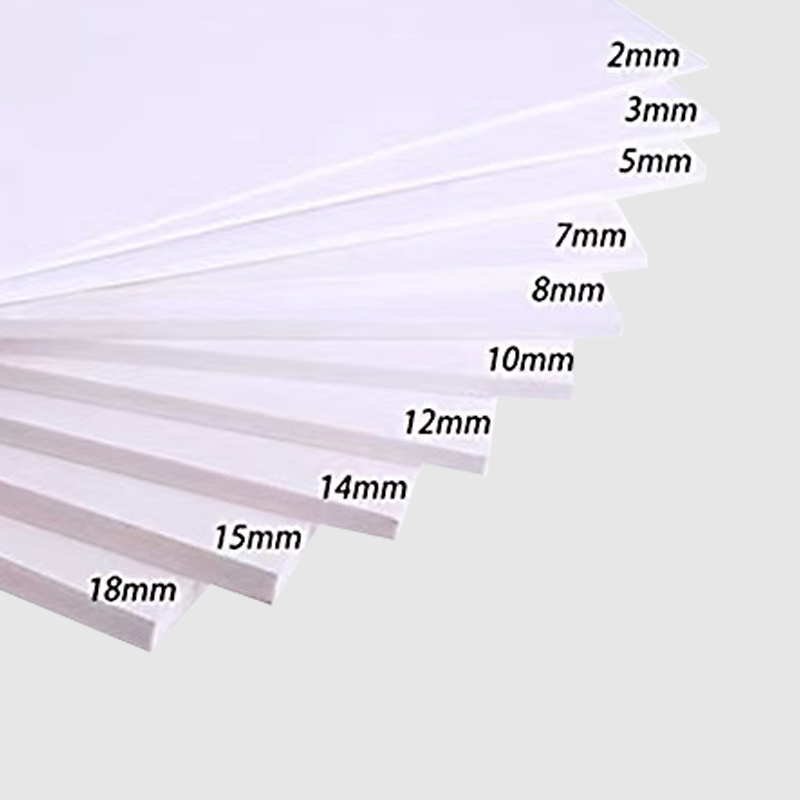
Thickness range3 – 25 mm
Colors availableWhite, grey, black, custom
Max service temp60 – 78°C (grade dependent)
Flame ratingSelf-extinguishing (B2 / V-0)
Water absorption< 0.5% (24-hr immersion)
Thermal conductivity0.05 – 0.08 W/mK
RecyclableYes — PVC is recyclable
Recommended NEWS:
Waterproof and moisture-proof performance of WPC Foam Board: materials, technology, application and maintenance
PVC Free Foam Board's multiple applications and environmental advantages in the field of transportation
What environmental measures are used in the production of White Laminated PVC Free Foam Boards?
What factors affect the appearance of High Density Waterproof PVC Composite Boards Wall Panel?
Environmental sustainability of High Density 4*8 ft Waterproof WPC Foam Boards
In public facility construction and home decoration, how does Waterproof PVC Celuka Foam Sheets meet the dual needs of waterproofing and sound insulation?
Related Products

Jiatao Industry Co., Ltd. is a professional manufacturer of polyvinyl chloride plastic boards in China, dedicated to the production of PVC foam boards, plastic wood foamboards, as well as colorful pVC for extruded foam board sheet manufacturers.
-
ADDRESS
No.65 Liminba, Yinong Town, Xiaoshan District, Hangzhou, Zhejiang, China
-
EMAIL
-
PHONE
+86-17816178586
MOBILE SITE



Copyright © Jiatao Industry Co., Ltd. All Rights Reserved.
Custom Rigid PVC Plastic Foam Boards Suppliers

Contact Us